
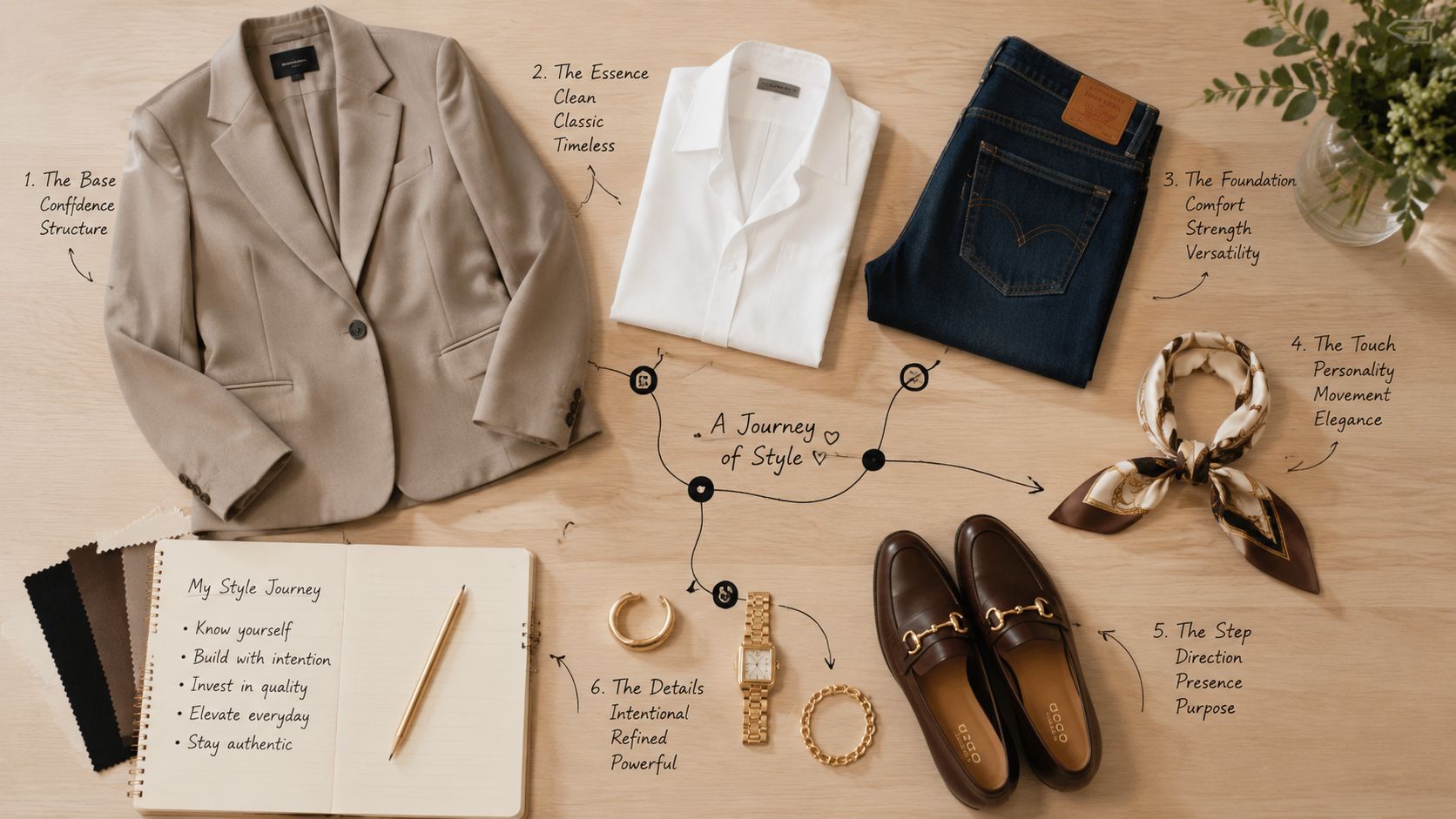
Most advice on a personal style guide gets the sequence wrong. It starts with aesthetics, shopping lists, and inspiration images, then hopes your real life will somehow fit around them.
That approach fails because clothes don't live on a mood board. They live in calendars, airports, client meetings, school runs, dinners, weather shifts, and repeat wear. A useful personal style guide isn't a visual fantasy. It's an operating system for personal presence.
When the system is sound, getting dressed takes less effort, purchases become easier to justify, and your wardrobe stops fighting your schedule. That matters more than owning more pieces. It also creates something far more valuable than novelty, which is ownership confidence.
Defining Personal Presence Beyond Aesthetics
The common assumption is that personal presence comes from taste alone. It doesn't. Taste matters, but without context, taste produces a closet full of isolated decisions.
A strong personal style guide solves for function first. It answers practical questions. What do you wear when the day moves from video calls to an in-person meeting? What holds shape after travel? Which pieces work in different climates without looking improvised? Those are the questions most style content avoids.
That gap is measurable. A 2024 study by the Fashion Innovation Council found that 74% of affluent shoppers abandon style advice content when it doesn't include lifestyle-integrated outfit formulas (Fashion Innovation Council reference). People don't need more abstract inspiration. They need formulas that work across real contexts without constant reinvestment.
Where most advice goes wrong
Most guides focus on image categories. Minimalist. Romantic. Classic. Modern. Those labels can be useful shorthand, but they don't tell you what to pack for a two-day work trip, how to dress for a hybrid schedule, or how to choose shoes that work from morning to evening without compromising professional authority.
That's why the best personal style guide starts with constraints, not fantasies.
- Schedule reality: Your wardrobe has to serve the week you live.
- Movement demands: Commutes, flights, walking distance, and climate matter.
- Role shifts: Many people move through professional, social, and personal contexts in a single day.
- Maintenance tolerance: If a piece requires care you won't consistently give, it isn't a strategic piece.
Personal presence isn't built by owning more options. It's built by reducing friction between your wardrobe and your life.
There's a parallel here with grooming and presentation. Clothing rarely works in isolation. Skin, hair, and overall maintenance affect how polished a look reads, which is why practical resources like expert beauty personal care tips are useful alongside wardrobe planning. The point isn't perfection. It's coherence.
What a better framework looks like
A useful guide does three things at once:
| Focus | Weak approach | Working approach |
|---|---|---|
| Identity | Copies an image | Defines repeatable signatures |
| Function | Treats every purchase separately | Builds around recurring needs |
| Spending | Reacts to temptation | Uses cost-per-wear math and role clarity |
If your clothes look good only in one setting, the system is weak. If the same core pieces move between settings with minor adjustments, the system is working.
The Foundation An Audit of Your Real-World Demands
Before you evaluate a single garment, audit the life it's supposed to serve.
Modern style discovery gets this right. The foundational principle is that the process is "80% clarity and maybe 20% shopping," and the method runs through four stages: self-reflection, inspiration curation, wardrobe audit, and intentional shopping (Cedar and Lily Clothier on personal style). Many individuals invert that ratio. They shop first, then try to explain the purchase afterward.

Start with a written operating brief
A personal style guide should begin as a document, not a shopping cart. Keep it simple, but make it specific.
Record the contexts that show up repeatedly:
Professional settings
Note the dress level expected in your actual work life. Not the idealized version. Think client-facing meetings, internal office days, remote presentations, networking dinners, and travel days.Personal obligations
Include school logistics, caregiving, social events, weekends, and errands. A wardrobe that only solves for work is incomplete.Climate and movement
Write down the temperatures you deal with, whether you walk a lot, whether you drive, and whether you're often moving between indoor and outdoor environments.Friction points
Identify what consistently goes wrong. Trousers wrinkle too fast. Shoes don't survive long days. Jackets look sharp but don't layer well over knitwear. These details matter more than trend language.
Audit the week, not the closet
The most useful audit is calendar-based. Review recent weeks and look for recurring scenarios. That tells you what your wardrobe is required to do.
Use prompts like these:
- Which outfits do you repeat without regret?
- Which categories create hesitation every morning?
- What do you avoid wearing because the fit, fabric, or maintenance doesn't suit the day?
- Where do you keep overspending because no stable formula exists?
Practical rule: If you can't describe your wardrobe needs in writing, you're not ready to buy strategically.
Turn observations into requirements
By the end of the audit, you should be able to produce a short list of requirements rather than a vague style identity.
For example:
- Hybrid work requirement: polished on camera, credible in person, comfortable through long seated hours.
- Travel requirement: resists visible wear, layers easily, works with limited luggage.
- Social requirement: adapts from daytime to dinner with a change of accessories or shoes.
A personal style guide proves its worth. It stops being about what you like in theory and starts defining what earns a place in your rotation.
Building Your Wardrobe Infrastructure
Once the audit is clear, foundation pieces become easier to identify. They aren't generic basics. They're the garments that carry the most responsibility in your life.
A good foundation piece does at least three jobs well. It supports repeated wear, works across multiple contexts, and holds visual authority without requiring rescue from accessories. If a piece only works in one narrow use case, it may still be enjoyable, but it isn't infrastructure.

Why constraint improves judgment
Disciplined systems can be helpful. Project 333, introduced around 2014, requires selecting exactly 33 items for a three-month season, forcing a quarterly review and reinforcing the value of fewer, higher-quality pieces (Myindyx on personal style systems). You don't need to adopt the system exactly as prescribed to benefit from the logic behind it.
Constraint reveals what performs. When choice narrows, weak pieces become obvious. So do strong silhouettes.
What counts as a foundation piece
Most wardrobes need a compact core before they need anything expressive. The exact pieces differ, but the test is consistent.
A foundation piece should have:
- Context flexibility: It works in more than one part of your life without looking misplaced.
- Shape retention: The proportions hold through repeated wear and routine maintenance.
- Low coordination burden: It pairs easily with the rest of your wardrobe.
- Role clarity: You know exactly why it exists and when you wear it.
A practical shortlist
For many professionals, a workable starting infrastructure is often five to seven pieces chosen from actual need rather than convention. A shortlist might include:
| Category | What you're looking for | Why it matters |
|---|---|---|
| Blazer | Structured line, reliable fit, room for layering | Restores professional authority quickly |
| Trousers | Clean drape, comfortable rise, repeatable shoe pairing | Handles high-frequency wear |
| Dress | Works alone and under layers | Solves fast decision days |
| Knitwear | Refined enough for meetings, soft enough for travel | Bridges formal and informal use |
| Outer layer | Appropriate weight and shape for your climate | Prevents the rest of the outfit from collapsing |
| Shoe | Can manage long wear and still read intentional | Protects the whole system |
| Bag | Carries daily reality without compromising line | Supports function and polish |
Headshots are a useful test because they expose whether your wardrobe communicates clearly. If you're refining those visual signals, What to wear for LinkedIn headshots offers practical guidance on line, color, and presentation.
A personal style guide becomes durable when these pieces work together without effort. If every foundation piece requires a rescue item to feel complete, the base isn't stable enough.
The Calculus of Strategic Acquisition
Acquisition is where discipline either holds or collapses. Once the wardrobe system is defined, shopping becomes a capital-allocation decision, not a search for novelty.
The useful question is simple: what job will this piece do in your actual week? Hybrid meetings, client dinners, conference travel, weather shifts, long walking days, and carry-on limits all create pressure on a wardrobe. A strong purchase reduces friction across those conditions. A weak one looks promising in isolation and fails once real life starts asking more of it.

Use cost-per-wear math with real operating costs
Cost per wear remains one of the cleanest filters, provided you calculate it like an owner rather than a shopper. Include purchase price, care, repairs, and any realistic resale value. Then estimate wear frequency based on your actual calendar, not the life you imagine dressing for.
That shift matters. A lower-priced item that twists, pills, or only works with one shoe often becomes expensive fast. A higher-priced piece can earn its place if it holds shape, travels well, and works across multiple settings over several seasons.
I use a blunt standard here. If an item needs special circumstances to make sense, it is a poor candidate for core budget. Buy for projected use. Identity purchases have a place, but they belong after the system is doing its job.
Allocate budget by return, not category prestige
Budgets work better when they follow frequency and impact. Put more money behind the pieces that carry visual authority, absorb repeat wear, and need to perform under pressure. In many wardrobes, that means tailoring, outerwear, shoes, and bags get more scrutiny than trend items because failure in those categories is more visible and more disruptive.
This is also where trade-offs become clear. A great bag can sharpen simple clothing, but only if it fits your daily load and travel habits. A beautiful shoe is a bad investment if you avoid it after forty minutes. A blazer with perfect structure is still underperforming if it cannot layer over the knitwear you wear three days a week. If you're assessing whether a bag will work across your schedule, this guide on how to style designer bags for every occasion is useful for judging versatility rather than just appearance.
Expressive purchases still belong in the wardrobe. They need a defined role, a clear pairing path, and enough use to justify the spend.
Use a buying filter that reflects your real constraints
A disciplined acquisition filter should account for lifestyle mechanics, not just taste:
- Gap test: Does it solve a specific deficiency already identified?
- Context test: Can it move across the settings you inhabit, such as office days, travel, dinners, events, or weekends?
- Pairing test: Will it work with several existing pieces without forcing follow-on purchases?
- Comfort test: Can you wear it for the duration your schedule demands?
- Care test: Are the cleaning, storage, and repair requirements realistic for your routine?
- Exit test: If it disappoints, can you resell it, tailor it, or reassign it to a narrower use case?
One failed test does not always kill a purchase. Two or three usually should.
One strong purchase can reset the whole system
The highest-return acquisitions improve the performance of multiple pieces already in rotation. A well-cut blazer can stabilize dresses, trousers, and denim. A refined flat or low heel can cover office, transit, and evening without forcing a bag change or backup shoe. A structured bag can restore line and intent to otherwise quiet outfits.
Feinheit FZ LLC offers tools and editorial guidance around finding personal style, which can help if you're trying to define those gaps before buying. The practical standard is narrower than many people expect. If a piece does not improve the wardrobe you already have, it does not deserve priority.
Good acquisition strategy reduces options. It does not expand them.
Achieving Context Flexibility Through Strategic Pieces
Foundation pieces carry the load. Strategic pieces change the setting.
In this way, many wardrobes become more useful without becoming larger. You don't need multiple versions of the same outfit for every occasion. You need a small set of modifiers that shift tone, authority, and function.

Think in formulas, not outfits
A formula is more durable than a look. It gives you a repeatable structure that can move across environments.
Take one base: well-cut trousers, a fine knit, and a structured bag.
That same base can shift in clear ways:
- For client meetings: add a blazer, refined shoe, minimal jewelry.
- For travel: switch to a softer outer layer and a practical shoe.
- For dinner: change the bag scale, add a stronger earring or belt, and sharpen the shoe.
The core remains stable. Only the signal changes.
The highest-return strategic pieces
Not every accessory is strategic. A strategic piece changes more than appearance. It changes function.
Good examples include:
| Strategic piece | What it changes | Best use |
|---|---|---|
| Shoe swap | Formality, mobility, authority | Day-to-evening movement |
| Belt | Waist definition, structure, polish | Dresses, knitwear, trousers |
| Scarf | Color, texture, climate response | Travel and transitional weather |
| Jewelry | Focus point, finish level | Meetings, evenings, portraits |
| Bag | Practical capacity and visual line | Workdays, events, commuting |
A useful bag strategy is often the difference between an outfit that feels complete and one that feels unresolved. For practical examples, how to style designer bags for every occasion is worth reviewing because bag scale, structure, and finish affect context more than is commonly understood.
The smartest wardrobes don't chase novelty. They learn how to redirect the same core garments into different situations.
A simple test for context flexibility
Use one base outfit and ask whether three different settings can be handled by changing only secondary elements. If the answer is yes, your system has flexibility. If the answer is no, the issue usually isn't lack of clothing. It's weak strategic support.
This is why a personal style guide should include formulas such as:
- Meeting formula
- Travel formula
- Evening formula
- Low-effort off-duty formula
Write them down. Repeat them until they become automatic. Repetition isn't failure. It's evidence that the system works.
Investment Protection and Seasonal Adaptation
A wardrobe starts losing value the moment care becomes reactive. Price does not make a piece strategic. Continued performance does. For anyone balancing office days, remote work, travel, and shifting climates, maintenance is what keeps a wardrobe usable across contexts instead of expensive but fragile.
The ownership test is straightforward. Can the piece still do its job after a heavy month of wear, a trip, a weather shift, or a minor change in fit? If the answer is no, the problem is rarely the item alone. It is usually weak storage, delayed repairs, poor cleaning habits, or a purchase that never matched real-life demands in the first place.
As noted earlier, true ownership cost includes what happens after checkout. Condition affects longevity, alteration potential, and resale prospects. Neglect turns a versatile piece into a short-term one.
Protect value through routine, not rescue
Good maintenance is operational. It should be built into the wardrobe system the same way tailoring, acquisition criteria, and outfit formulas are built in.
- Store for structure: use the right support for jackets, bags, and knits so shape does not collapse between wears.
- Repair at first failure point: sole wear, loose hems, missing buttons, and stretched straps are low-cost fixes early.
- Clean with restraint: too much cleaning wears fabric down. Too little lets stains and odor set.
- Watch friction points: underarms, inner thighs, cuffs, and shoulder contact reveal whether a garment suits your routine.
- Rest high-use items: shoes, bras, knitwear, and structured garments last longer when they are not worn back-to-back without recovery time.
Ownership principle: Condition preserves options. A well-kept piece can stay in rotation, be altered, travel well, or leave the wardrobe with value intact.
Adapt seasonally without rebuilding everything
Seasonal adaptation should solve functional changes, not trigger identity drift. The base system stays the same. What changes is fabric weight, layer count, weather protection, and the role of accessories.
This matters most for wardrobes built around real constraints. Hybrid schedules demand clothing that can move between camera-ready polish and physical commuting. Travel requires pieces that resist wrinkling, layer well, and handle repetition without looking repetitive. Climate shifts call for insulation, ventilation, and footwear changes, not a full aesthetic reset.
A quarterly review keeps those adjustments disciplined. Assess three points:
What carried real load
Keep the pieces that handled repeated wear, movement, and weather with little effort.What failed in practice
Remove items that demanded special handling, never felt right on the body, or only worked in narrow conditions.What function is missing next
Add only what closes a gap. That might be a lighter outer layer, weather-ready shoe, breathable trouser, or one bag that travels better.
For a focused example, this summer investment framework built around cost-per-wear for Canadian summer and beyond shows how seasonal buying works best when it extends an existing wardrobe system.
The trade-off is clear. Reactive seasonal shopping creates volume. Methodical adaptation protects spending, reduces replacement cycles, and keeps personal presence consistent through changing conditions.
Conclusion
A personal style guide works when it reduces decisions, protects spending, and strengthens personal presence across the situations that fill your calendar. The true measure isn't how interesting the wardrobe looks on a rail. It's how consistently it performs in motion.
Clarity should come first. Infrastructure comes next. Acquisition should stay disciplined. Then maintenance keeps the whole system credible over time.
At theFeinheit, luxury is about finding pieces that multiply your options, not consume your budget. One strategic investment beats five impulse purchases. Explore our collection of over 13,000 products from 160+ leading brands to build wardrobe infrastructure that endures. Discover your power at theFeinheit.
For shoppers who want a more disciplined approach to personal presence, Feinheit FZ LLC offers access to fashion, accessories, and editorial guidance designed around strategic buying rather than impulse accumulation.
