
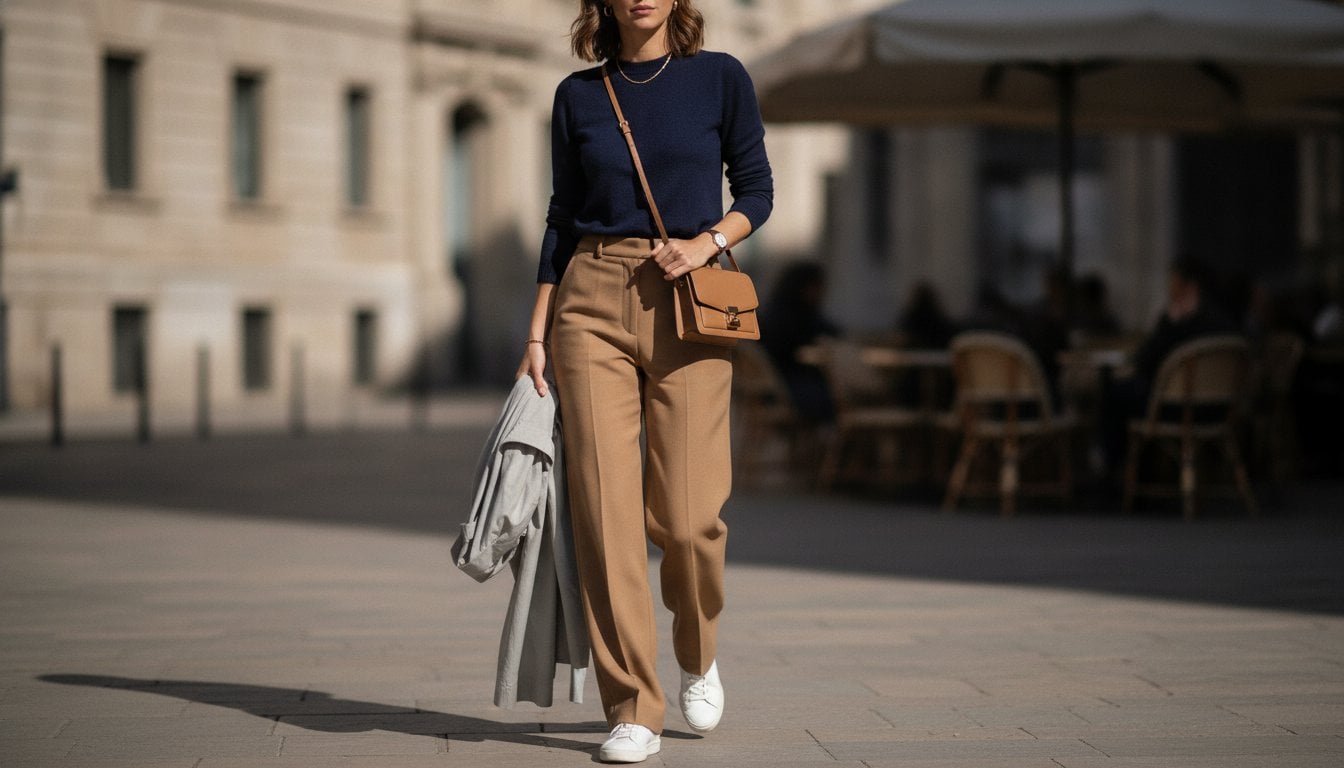
Most advice on how to dress casually elegant fails because it starts with objects. Buy a blazer. Add loafers. Wear neutrals. That approach creates a closet full of individually respectable items and very little consistency.
Casual elegance isn't an item list. It's a system for reducing visual noise. The point is to look composed without looking overworked, and to do it repeatedly across real life: office mornings, travel days, dinners, client meetings, weekends. If your wardrobe only works when you “dress up,” it isn't working hard enough.
That shift in mindset matters because casual dressing now dominates how people live. The global casual apparel market is projected to reach $321.31 billion by 2024, and over 71% of consumers aged 18–44 prefer casual over formal wear, according to Wise Guy Reports' casual apparel market analysis. That doesn't mean standards have dropped. It means ease has become essential, and elegance has to operate inside that reality.
The answer isn't more choice. It's strategic limitation. A smaller set of well-selected shapes, disciplined color relationships, and refined materials will do more for your personal presence than a larger wardrobe built on novelty.
Redefining Casual Elegance Beyond the Obvious
The most common mistake is treating casual elegance as softened formalwear. That's why so many people end up in outfits that feel technically correct but visually strained. A blazer over a poor knit, stiff trousers with the wrong shoe, expensive pieces fighting each other for authority. The result is effort, not ease.
Casual elegance works when the outfit reads intentional at a glance and comfortable up close. That requires a visual signature. You need repeatable proportions, reliable fabrics, and enough restraint that the wardrobe starts making decisions for you.
Why the checklist approach breaks down
A single “smart” item can't rescue a weak system. If the trousers collapse at the knee, the knit pills, or the shoe is too casual for the rest of the outfit, the look loses authority. Brand recognition doesn't solve that. Construction, balance, and repetition do.
This is why polished daily dressing usually comes from infrastructure, not shopping excitement. The right wardrobe removes friction. You know what works together because the pieces were selected to cooperate from the beginning.
Practical rule: If a piece only works with one exact outfit, it's probably decoration, not wardrobe infrastructure.
A useful reference point is to study polished work-to-weekend outfits that keep structure while relaxing the formality. The strongest examples don't rely on louder styling. They rely on clean lines, steady proportions, and materials that hold shape.
What casual elegance actually asks for
It asks for discipline in three places:
- Shape first: Repeat silhouettes until they become your baseline.
- Material second: Choose fabrics that drape cleanly and recover well.
- Styling third: Use accessories and layering to adjust context, not to create personality from scratch.
That order matters. Most wardrobe mistakes come from reversing it. People try to accessorize their way into coherence when the foundation pieces were never aligned.
If you want to understand how to dress casually elegant, stop asking what to buy next. Ask what your wardrobe is trained to do on an average weekday. That answer is usually more revealing than any mirror.
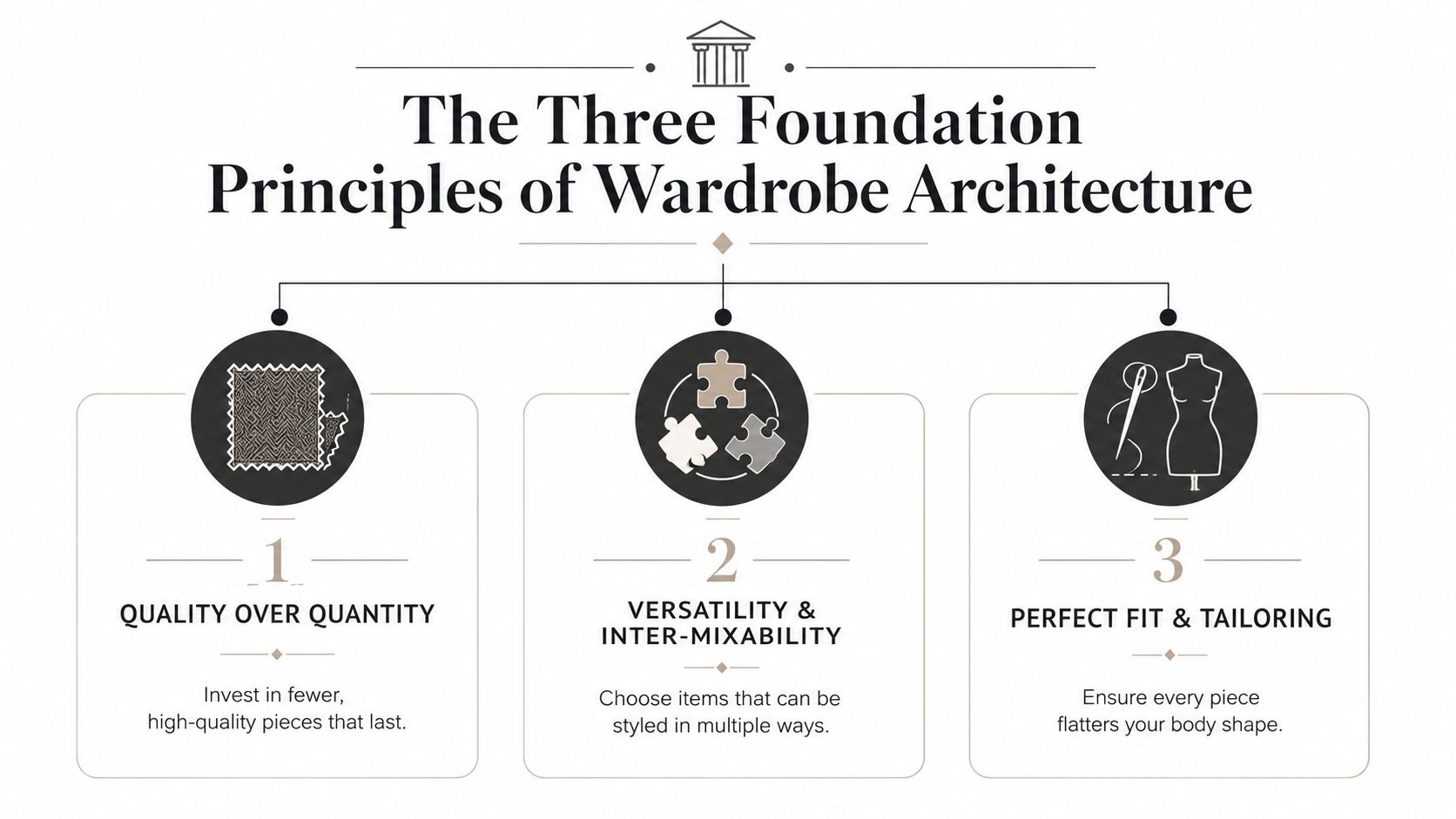
The Three Foundation Principles of Wardrobe Architecture
The cleanest wardrobes follow a few fixed rules. They don't leave every morning to chance. Once those rules are in place, getting dressed becomes faster and more precise.
Silhouette Lock
The most useful technical principle is Silhouette Lock. Choose one dependable top silhouette and one dependable bottom silhouette, then repeat them until they become your visual architecture. That might mean a fitted fine-gauge knit with straight-leg trousers, or a relaxed shirt with a narrow ankle trouser. The exact formula matters less than consistency.
Many wardrobes go wrong. They combine a relaxed blazer with loose trousers and call it modern. In practice, that usually reads unfinished. A better solution is the structured-relaxed balance: one piece carries shape, the other supplies ease.
Use this quick filter when assessing combinations:
- If the top is relaxed: Keep the trouser cleaner and more controlled.
- If the trouser has volume: Hold the upper half closer to the body or add waist definition.
- If both pieces feel soft: One of them needs more structure, usually through fabric or cut.
Palette discipline
Color should simplify decisions, not create them. Style audits show that keeping a neutral foundation palette of black, white, navy, camel, and gray for 70% of the wardrobe increases outfit cohesion and reduces morning styling time by approximately 40%, according to Emily Capell's guide to finding your outfit style.
That doesn't mean dressing without character. It means your base does the heavy lifting, so accent pieces can work harder with less effort.
A neutral base makes contrast look intentional. Without that base, contrast often looks accidental.
A disciplined palette gives you two concrete advantages:
| Benefit | What it changes in practice |
|---|---|
| Outfit cohesion | More pieces combine cleanly without visual friction |
| Decision speed | Fewer failed combinations before leaving the house |
| Context flexibility | The same garment works across work, travel, and dinner |
Fabric integrity
Fabric is where elegant casual dressing either holds or collapses. The right material creates presence before anyone notices the label. Look for natural fibers with clean surface texture and enough body to maintain line through the day. Merino, cashmere, linen, cotton poplin, refined denim, and substantial wool blends tend to perform well when the cut is disciplined.
Poor fabric announces itself quickly. It twists, shines, clings, bags out, or loses edge after a few wears. Casual clothing gets used often, so fabric failure shows up early.
When people ask how to dress casually elegant, they usually expect a styling trick. The straightforward answer is less glamorous. Repeat the right shapes, narrow the palette, and refuse fabrics that look tired before the day is over.
Constructing Your Wardrobe Frame
Individuals often overspend on visible novelty and underspend on the garments that define their presence. That's backwards. The wardrobe frame carries the silhouette, sets the level of formality, and determines whether the rest of the outfit has any authority.
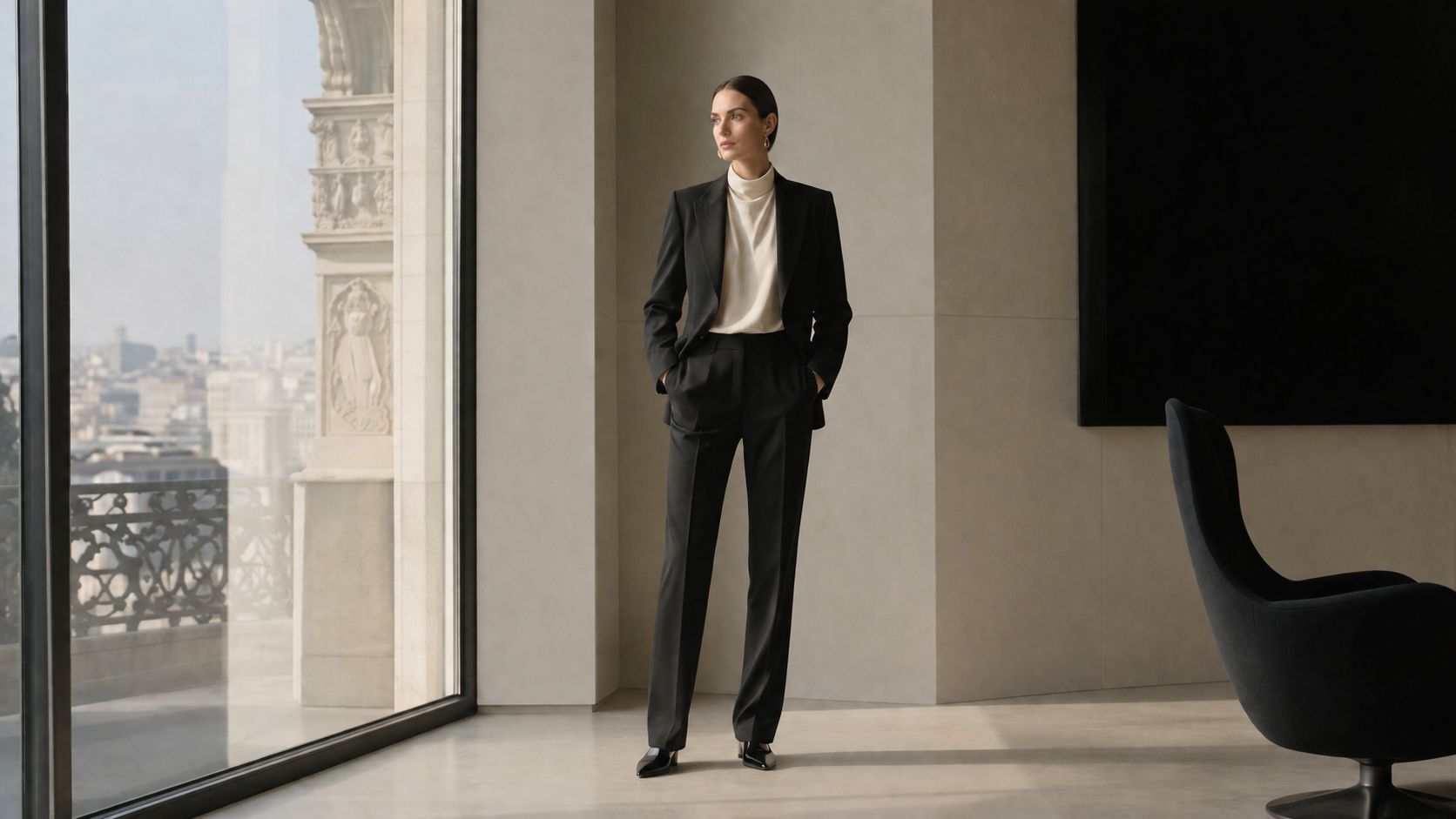
A practical budgeting rule makes this easier to manage. A functional wardrobe budget follows a 70/30 allocation rule, with 70% of spending directed to the frame, meaning jackets, trousers, and coats, and 30% to consumables and mood items, according to MioLook's wardrobe budget guide. That split is useful because it mirrors reality. The structural pieces shape every outfit. The rest support them.
Start with the pieces that control silhouette
If you're rebuilding a wardrobe, begin with the garments that anchor proportion:
- Trousers: A proper wool trouser, dense cotton trouser, or refined straight-leg pair does more for professional authority than a stack of forgettable tops.
- Outerwear: A coat, cropped jacket, or softly structured blazer changes the entire read of an outfit before you say a word.
- Core knitwear: Fine-gauge knits and clean cardigans bridge work and leisure without visual drop-off.
These pieces deserve the best fabric and fit your budget allows because they determine whether an outfit looks designed or assembled at the last minute.
What deserves less budget
Consumables matter, but they shouldn't dominate spending. T-shirts, trend-led tops, novelty accessories, and seasonal experiment pieces wear out faster or lose relevance sooner. They serve a role, but not a structural one.
That doesn't mean buying the cheapest option. It means keeping proportion. A wardrobe full of impressive “finishing touches” with weak trousers and poor outerwear is financially inefficient. It looks uneven because it is uneven.
The strongest closet usually isn't the largest one. It's the one where the frame is doing most of the work.
A better way to think about categories
Instead of shopping by item type, shop by job description. Ask what a piece has to do across your week.
| Category | Its real job |
|---|---|
| Trousers | Hold line, support multiple tops, work with more than one shoe |
| Jackets and coats | Set the outfit's authority and sharpen proportion |
| Knitwear | Add softness without losing structure |
| Consumables | Refresh the frame without competing with it |
Context flexibility is particularly valuable. A strong coat with clean shoulder line can cover a simple knit and trouser combination and still read intentional. A weak coat can ruin a strong outfit in seconds.
For high-value clients, I usually push resources toward the pieces that survive repetition. That's where extended lifespan and cost-per-wear math become visible in daily life, not just on paper. You feel it when the same trouser works on Monday with a knit, on Thursday with a shirt, and on Saturday with a lighter jacket, all without looking repetitive.
The Mathematics of Selecting Strategic Garments
Price isn't the right question. Performance is. If you want to buy fewer pieces and get more use from each one, you need a method that strips emotion out of the decision.
The most practical tool is cost-per-wear. The formula is (Purchase Price + Alterations + Repairs) / Number of Times Worn, and for everyday pieces a CPW under $3 is considered excellent, while under $10 is acceptable for occasion wear, according to The Frugal Glow's cost-per-wear formula guide. The useful discipline here is that it forces you to count the actual cost paid, not the fantasy version.
Why sticker price misleads
A cheaper garment often becomes expensive because it fails operationally. It loses shape, needs replacing, or sits unworn because the fabric feels wrong. A better-made alternative may cost more upfront and still deliver stronger return because it enters your weekly rotation without friction.
This is especially relevant in casual elegance, where garments have to survive repeated wear. Clothes that only look good at purchase don't protect your budget. Clothes that keep their line do.
Here's a simple comparison model.
| Metric | Garment A (Fast Fashion) | Garment B (Investment Piece) |
|---|---|---|
| Purchase approach | Lower upfront price, minimal tailoring | Higher upfront price, tailored to fit |
| Fabric behavior | Surface often degrades faster, shape can collapse | Better drape, stronger recovery, cleaner line |
| Frequency of wear | Often avoided after initial excitement | More likely to enter regular rotation |
| Repair logic | Usually replaced rather than maintained | Worth repairing and preserving |
| CPW outcome | Can become poor value if rarely worn | Can justify itself through repetition |
Use CPW with judgment, not as an excuse
Cost-per-wear math works best when combined with honest questions:
- Will this piece work in at least two distinct contexts? Work and dinner. Travel and weekend. Office and off-duty.
- Will I tailor it if needed? An almost-right fit usually becomes a rarely worn piece.
- Does the fabric support repetition? If the answer is no, the CPW projection is probably fiction.
- Can it integrate with my existing frame? If not, you're not buying one garment. You're buying the additional purchases required to justify it.
A strategic purchase doesn't need to be worn with everything. It needs to work hard with the right things.
For a practical companion to this thinking, the strategic summer investment approach for building a cost-per-wear foundation is useful because it treats seasonal buying as system building rather than entertainment.
Buy the garment you'll reach for without negotiation. That's the one that usually wins on cost-per-wear.
People often ask how to dress casually elegant on a realistic budget. The answer isn't to chase lower prices. It's to stop paying repeatedly for pieces that were never capable of long-term service.
Mastering Outfit Composition and Fit
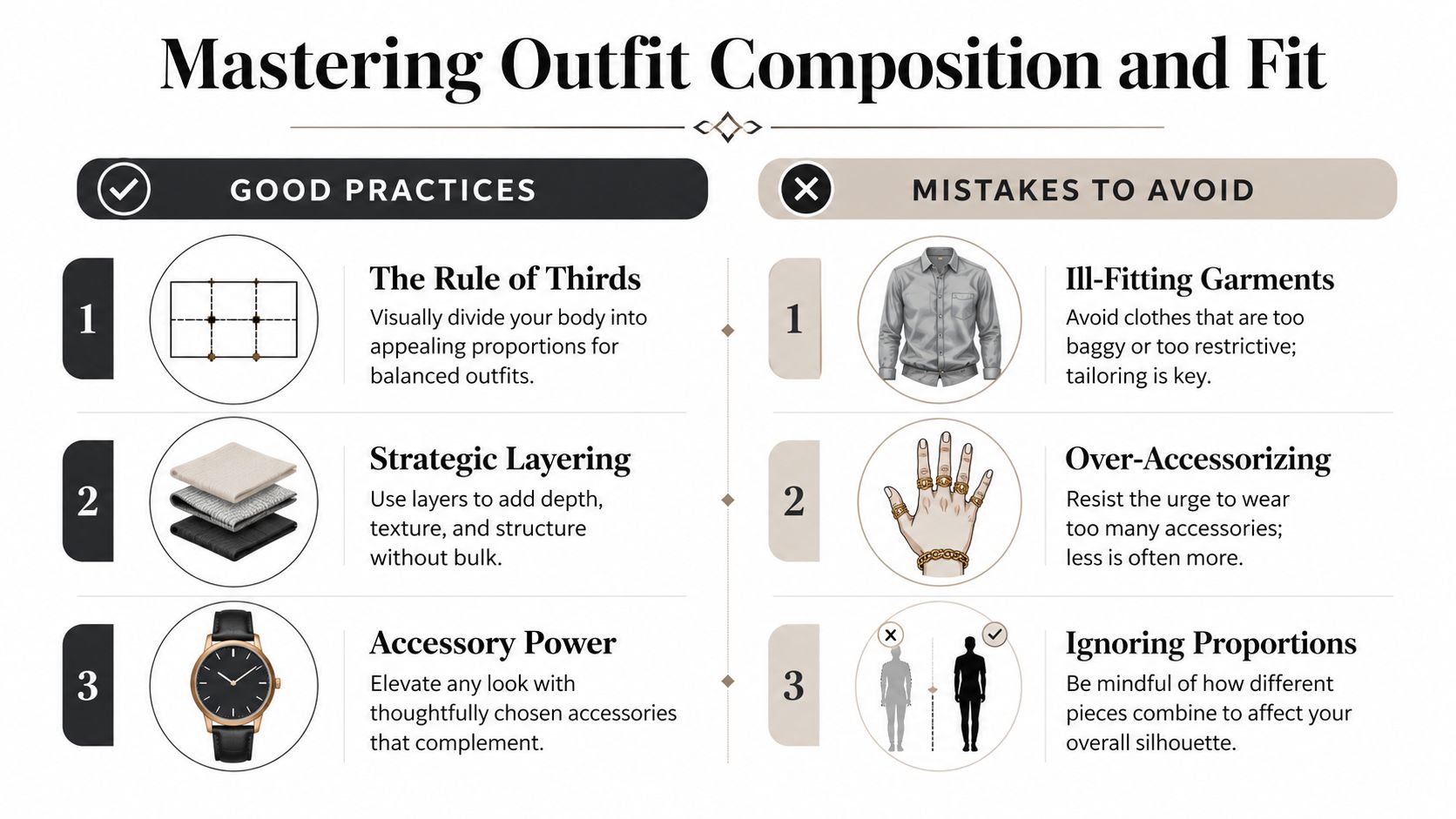
Good clothing can still fail in execution. Most outfits lose polish at the composition stage, where proportion, layering, and finishing either reinforce each other or compete.
Fit standards that actually matter
Precision beats fussiness. Shirts should finish at the wrist. Trousers should fall with a clean break over the shoe, not puddle and not hover awkwardly above it. Jackets should allow movement while still holding line at the shoulder and waist.
Most fit problems come from tolerance creep. People get used to extra sleeve length, collapsed hems, stretched waistbands, and bulky layering. Then they wonder why the outfit feels off. Casual elegance depends on controlled ease, not accidental looseness.
Use this short checkpoint before leaving:
- Sleeves: End at the wrist, not over the hand.
- Trouser line: Clean break, no sagging through the leg.
- Shoulders: Natural and defined, never collapsing outward.
- Waist area: Enough room for comfort, not enough to distort shape.
Layering without bulk
The best layering follows a thin-to-thick logic. Start with the lightest, closest layer, then build outward with more structure and weight. That keeps the outfit visually coherent and physically comfortable.
A fine knit under a softly structured jacket works because each layer has a distinct role. A heavy hoodie under a weak overshirt usually doesn't, because both layers ask for visual dominance and neither provides control.
When layers are fighting for space, the outfit starts looking defensive instead of composed.
The athleisure problem
A major reason outfits lose authority is what can be called Athleisure Degradation. According to Menswear House's casual wear guidance, 75% of casual elegance failures stem from worn-out athleisure pieces that lack structural integrity. The fix isn't banning sporty elements. It's demanding condition and restraint.
That means:
- Choose clean sporty fabrics: Technical joggers in excellent condition can work with a sharp knit or leather sneaker.
- Reject faded basics: Washed-out leggings, stretched hoodies, and tired trainers undermine everything around them.
- Limit the casual signal: If one piece is athletic, the surrounding pieces should restore structure.
Accessories and proportion in real use
Accessories should help the body read in proportion. A watch, belt, or bracelet can direct the eye and sharpen the finish, but only when scale is right. If you wear a bracelet, fit matters as much as material. A loose, sliding piece makes the whole outfit feel less resolved. A useful reference is this Bracelet sizing guide 2026, especially if you're trying to keep jewelry precise rather than decorative.
Small corrections often outperform big changes. Hem the trouser. Clean the shoe. Remove the extra layer. Tighten the accessory scale. That's how an outfit starts reading deliberate.
The Strategic Role of Understated Accessories
Accessories are often misunderstood because people treat them as personality delivery systems. In a casually elegant wardrobe, they're adjustment tools. They fine-tune formality, reinforce texture, and complete the line of an outfit without competing with it.
The most effective accessories are usually restrained. Matte leather belts, suede footwear, a clean watch, a discreet ring, a structured bag. These pieces don't shout. They stabilize the outfit.
Texture matters more than display
When the goal is refinement, surface quality matters more than ornament. Matte finishes usually integrate better into casual elegance because they soften the transition between relaxed clothing and sharper elements. Gloss can work, but it raises formality quickly and often feels disconnected from otherwise quiet dressing.
Footwear is especially unforgiving. Clean suede loafers, polished matte leather derbies, or well-kept minimal sneakers can support a composed outfit. Scuffed shoes, loud hardware, or exaggerated soles usually pull the look off course.
Use fewer accessories with clearer purpose
Think in roles, not accumulation:
- A belt defines and cleans the waistline.
- A watch introduces authority and rhythm.
- A bag supports the outfit's level of structure.
- Shoes decide whether the look lands as intentional or unfinished.
That's enough for most situations. More isn't automatically better. In fact, too many accessories often create visual negotiation, which is the opposite of ownership confidence.
A strong accessory should confirm the outfit's message, not rewrite it.
Practical adjustments for everyday wear
There are cases where function leads. If you rely on a smartwatch for work, travel, or training, the strap becomes part of the visual equation. In that situation, cleaner material and color choices matter. For example, silicone bands for Apple and Samsung can make sense when you need comfort and utility, but choose subdued tones and a crisp fit so the watch supports the outfit rather than dominating it.
Understated accessories also offer investment protection. They tend to survive trend cycles better, pair with more of the wardrobe frame, and justify maintenance. A good belt or watch earns its place because it keeps resolving outfits over time. That's the test. Not whether it gets noticed first, but whether the whole outfit looks better because it's there.
Conclusion
Casual elegance isn't about dressing down carefully. It's about building a wardrobe that performs with consistency, ease, and clear standards. The right frame, disciplined composition, and honest cost-per-wear math create more options with less waste. That's what gives clothing real return.
At theFeinheit, luxury is about finding pieces that multiply your options, not consume your budget. One strategic investment beats five impulse purchases. Explore our collection of over 13,000 products from 160+ leading brands to build wardrobe infrastructure that endures. Discover your power at theFeinheit.
Explore Feinheit FZ LLC for strategic pieces that support context flexibility, stronger cost-per-wear math, and a wardrobe frame built for long-term return.