
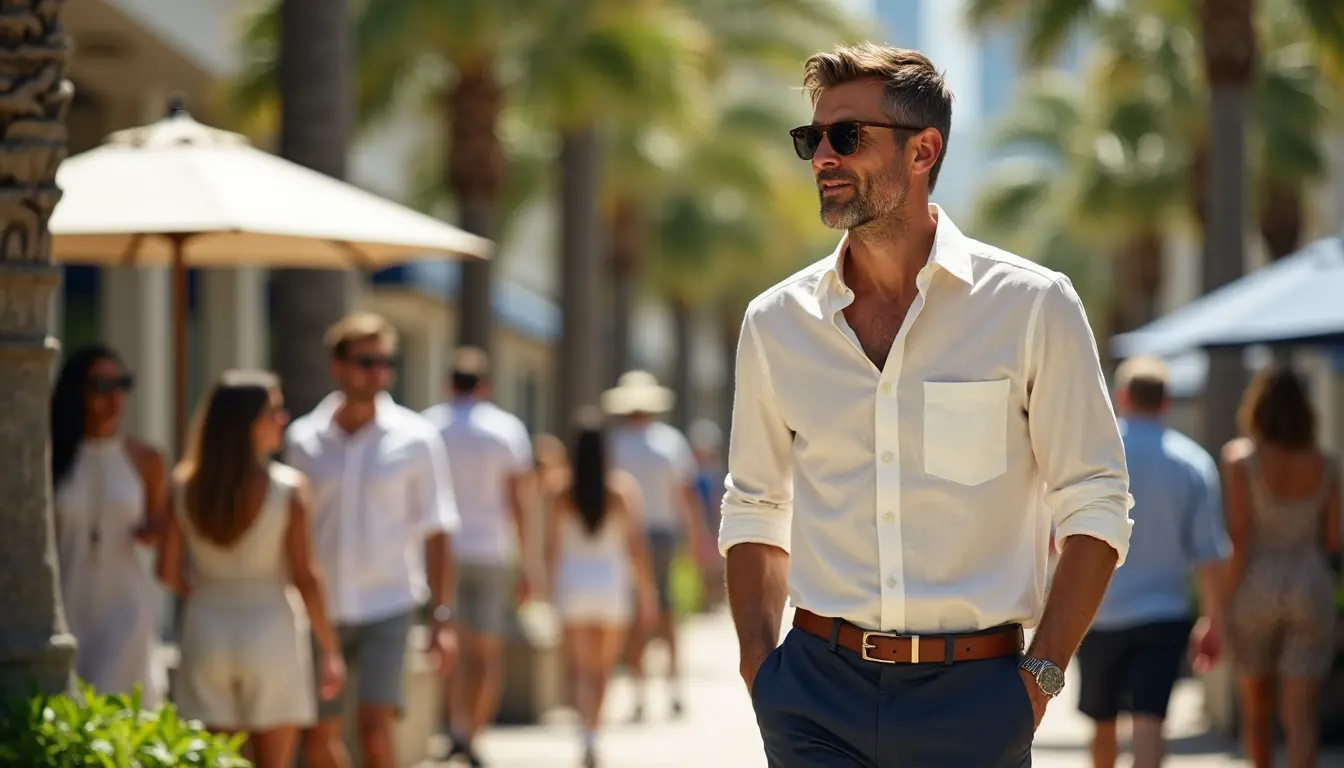
American summer operating at regional temperature extremes—Miami humid intensity (31°C), Phoenix dry heat (41°C), New York humid complications (26°C), San Francisco coastal cool (18°C), Dallas prairie warmth (32°C)—tests clothing construction through sustained heat exposure, humidity cycling, perspiration saturation, and extended outdoor activity impossible in office environments. These conditions separate genuine investment quality from budget alternatives masquerading as value through simple price reduction. The Tom Ford tropical wool trousers delivering flawless appearance through Miami rooftop business entertaining, the Lemaire linen shirt maintaining structure through Arizona summer heat, the Loro Piana construction surviving three consecutive seasons of intensive summer rotation—these pieces demonstrate that premium pricing reflects genuine performance advantage translating to multi-year durability, reduced replacement frequency, and superior cost-per-wear economics compared to budget alternatives requiring constant replacement.
Professional men investing in summer wardrobe face critical decision: purchase budget alternatives offering short-term affordability with hidden long-term cost accumulation, or invest premium pricing reflecting superior construction delivering extended lifespan and genuine cost advantage through ownership lifetime. Understanding this decision requires moving beyond price comparison to performance analysis examining actual durability through summer’s specific challenges—fabric resilience under heat stress, dye stability resisting sun fading, construction precision maintaining shape despite humidity cycling, and material integrity sustaining professional appearance across years.
American Summer Climate Variation and Performance Testing

Regional Heat Intensity and Fabric Stress
American summer temperature variation spans 23°C across regions (18°C San Francisco to 41°C Phoenix), each creating distinct fabric stress patterns testing construction quality through different mechanisms. This geographic diversity provides natural performance testing environment where investment versus budget comparison occurs authentically rather than controlled laboratory conditions.
Miami Humid Heat (31°C, 75%+ humidity): Sustained moisture exposure tests fiber resilience through humidity saturation. Premium tropical wool maintains fiber pliability and structure through moisture cycling; budget alternatives show brittleness within weeks of repeated humidity exposure-drying cycles. Perspiration saturation reaches 80%+ fabric weight on humid Miami days—investment pieces manage this moisture without weakening while budget alternatives develop permanent weakness and odor absorption.
Phoenix Dry Heat (41°C, 10-20% humidity): Extreme dryness tests fiber brittleness rather than moisture tolerance. Premium fibers resist drying-induced brittleness through superior molecular structure; budget fibers become stiff and prone to breaking. Extended outdoor exposure (yard work, weekend activities, professional outdoor events) creates mechanical stress—repeated movement, bending, reaching—that budget fabrics cannot withstand without fiber breakdown.
New York Humid Heat (26°C, 70% humidity): Moderate temperature with persistent humidity creates extended saturation cycles. Commuting between 19°C air-conditioned offices and 26°C humid exterior throughout day forces constant fiber adjustment—swelling and shrinking cycles that weaken inferior construction. Investment quality withstands this cycling; budget alternatives show permanent creasing unable to release through steaming by week two.
Dallas Prairie Heat (32°C, 40% humidity, intense sunlight): Moderate humidity combined with intense prairie sunlight creates dual stress—heat stress and UV exposure. Superior dyes resist sun fading across extended outdoor exposure; budget dyes show noticeable fading within 3-4 weeks of outdoor weekend activity. Intense sunlight combined with heat accelerates chemical degradation in inferior fibers.
San Francisco Coastal Cool (18°C, 65% humidity, layering requirement despite summer): Maritime influence prevents extreme heat while humidity requires breathability. Investment pieces prove necessary when lighter-weight options prove inadequate and winter-weight pieces create overheating. Budget summer pieces often inadequate for San Francisco’s true climate, forcing unnecessary additional purchases.
Quality Construction Details: Understanding Premium Pricing

Fiber Selection and Import Costs
Premium fabric pricing begins with fiber selection reflecting scarcity, quality grading, and import logistics. Investment brands source fibers through quality guarantees unavailable at commercial price points.
Loro Piana Merino and Wool Leadership: Loro Piana mills control entire supply chain—owning sheep farms, managing breeding for fiber fineness, supervising shearing quality, controlling fiber processing. This vertical integration ensures fiber grades impossible through commodity sourcing. Loro Piana Super 150s wool (11.5 micron fineness) represents top 0.3% of global wool production—inherently scarce, commanding premium pricing reflecting actual scarcity.
Budget manufacturers source through commodity markets accepting variable quality at consistent price. The trousers costing $600 utilize merged fiber sources, variable grades, and cost-driven processing prioritizing output over consistency. Premium investment pricing ($2,200-$3,500 for comparable Loro Piana pieces) reflects purchasing power supporting superior fiber selection unavailable through budget sourcing.
Italian Mill Tradition and Technical Expertise: Investment pieces processed through mills with 50-150+ year operational history. Como mills (Italian silk center), Biella mills (wool capital), and coastal finishing facilities developed technical mastery converting raw fiber into luxury material. This expertise—proprietary dyeing processes, controlled shrinkage finishing, hand-finishing techniques—costs money visible in final pricing. Budget manufacturers utilize basic mill processes, shorter processing timelines, and cost-driven finishing sacrificing durability for speed.
Import and Logistics Premium: Premium fabrics sourced from specialized suppliers incurring import costs, quality control inspections, inventory management supporting small-volume consistency. Investment brands investing in Italian fabric sourcing (approximately 30-40% of garment cost) guarantee material quality budget sourcing cannot match through equivalent price points.
Construction Precision and Seam Engineering
Investment piece construction prioritizes durability through stress-point engineering impossible under budget manufacturing timelines. Premium construction details determine whether garments age gracefully through years or deteriorate noticeably within months.
Seam Reinforcement and Stress-Point Design: Inseam stress points (especially trousers knee area, underarm shoulder areas) receive reinforced stitching or internal tape preventing stress failure. Tom Ford and Saint Laurent specifications include internal reinforcement invisible externally yet critical for durability. Stitching tension carefully controlled—too tight causes puckering, too loose causes stress failure. Budget manufacturing achieves only single-pass stitching without reinforcement, explaining why budget trousers show knee failure within 3-4 months while investment pieces tolerate years.
Buttonhole and Button Attachment Engineering: Investment shirts feature hand-finished buttonholes with reinforced stitching preventing fraying under repeated stress. Button attachment utilizes reinforced thread and shank construction preventing button loss—common issue destroying budget shirts within months. Button-hole degradation—fraying, enlargement, eventual failure—represents earliest visible quality differentiation.
Collar and Cuff Durability: Premium construction includes interfacing quality stabilizing collar shape through extended wear and washing. Budget interfacing breaks down within months of repeated laundering and heat stress; premium construction maintains shape across years. Collar curling (most visible quality defect) results directly from interfacing degradation—premium brands rarely experience this issue.
Real Summer Performance: Investment Versus Budget Comparison

Miami Summer Professional Entertaining Scenario
Context: Professional conducting outdoor summer entertaining, client meetings, and networking throughout Miami summer season (June-August). Outdoor rooftop events, beach club entertaining, outdoor business conferences comprise 30+ days annually in peak heat/humidity exposure. Professional requires appearance maintaining client confidence and business authority despite 31°C humid conditions.
Investment Quality Performance (Tom Ford tropical wool trousers, $3,200):
First summer (intensive rotation 3-4 wears weekly): Tropical wool engineered through Loro Piana mills responds to humidity through fine fiber structure and controlled shrinkage finishing. Perspiration exposure managing through fiber resilience—moisture absorbed without creating fiber weakness. Trousers maintain sharp crease throughout 4-6 hour events despite repeated sitting/standing cycles in heat and humidity. By season end, trousers show negligible visible wear—color intact, structure perfect, professional appearance unchanged.
Professional managing Miami summer appears consistently polished throughout season despite extreme heat/humidity stress. Business confidence not undermined by appearance anxiety. Clothing investment enabling business focus rather than appearance distraction.
Budget Alternative Performance (Generic $400 summer trousers):
First summer week 1-2: Budget construction tolerates initial heat reasonably. By week 3-4 (after 8-10 wears in Miami heat/humidity): Visible deterioration obvious—trouser knees developing permanent bagging, crease weakening, fabric beginning showing permanent wrinkling despite steaming. By week 6-8: Trousers showing definitive wear signs—color fading visible, knee area obviously weakened, professional appearance seriously compromised. Professional requires replacement and wardrobe expansion to maintain appearance standard.
Professional experiencing escalating appearance anxiety throughout summer as budget pieces deteriorate visibly despite light wear. Division of attention between business and appearance management anxiety undermines professional presence and client confidence perception.
Arizona Summer Outdoor Activity Scenario
Context: Professional or personal participation in outdoor summer activities—weekend golf, outdoor business conferences, summer travel to Phoenix-area destinations. Extended outdoor exposure (4-8 hours) to 41°C dry heat, intense prairie sunlight, mechanical activity stress (walking, bending, carrying, golf movement).
Investment Quality (Loro Piana or similar heritage brand linen shirt, $1,400-$1,800):
Fine linen sourced through Loro Piana mills, hand-finished through Italian processing. Extreme dryness creates fiber brittleness challenge—fine fibers resist brittleness through superior molecular structure. Extended outdoor sun exposure tests dye stability—premium vegetable-based dyes resist UV fading significantly outperforming synthetic dyes. After 4-hour golf or outdoor event in 41°C heat: Linen fabric breathing manages perspiration; shirt maintains comfortable feel despite heat. Dye color unchanged despite intense sun exposure. Fabric drape and structure intact despite extended wear.
Professional appearing polished and composed at end-of-day business dinner despite extended outdoor heat exposure. Investment fabric performance enabling professional authority and confidence.
Budget Alternative (Budget linen shirt, $100-$150):
Commercial linen sourced through commodity markets, basic finishing. Within first 2-3 hours outdoors in 41°C heat: Fabric becomes uncomfortable—fiber brittleness creating stiff, unpleasant feel. Moisture management inadequate, creating damp uncomfort. By 4-hour event completion: Visible color fading noticeable especially in sun-exposed areas. Dye bleeding potential in any moisture exposure. Fabric structure weakened by mechanical stress (golf movement)—sleeve seams showing stress. Professional appearing noticeably disheveled, uncomfortable, and less capable professionally despite actual capability level.
Multi-City Summer Travel: Temperature Transition Scenario
Context: Business travel spanning multiple US regions within single week—starting San Francisco (18°C coastal cool), transitioning to New York (26°C humid), ending Miami (31°C humid). Same garment wardrobe must function across 13°C temperature range, humidity variation, and diverse professional contexts. Multiple flights, airport transitions, rapid climate changes stress garment construction.
Investment Quality (ZEGNA or Saint Laurent tropical wool or linen-blend pieces):
Superior fiber selection and construction tolerates temperature cycling and rapid climate transitions. San Francisco cool benefits from tropical weight providing adequate warmth without overheating. New York heat benefits from breathable construction managing humidity. Miami heat benefits from moisture tolerance and durability. No single piece inappropriate for any destination context. Professional maintaining consistent appearance across region transitions—not requiring wardrobe changes or alternate pieces for different climate contexts.
Travel efficiency maximized through versatile investment pieces performing across diverse contexts. Business advantage through streamlined packing and wardrobe flexibility. Professional presenting consistent appearance regardless of destination climate.
Budget Alternative (Mixed fast-fashion pieces):
Budget pieces inadequate for entire range. San Francisco coastal cool requires excessive layering making pieces inadequate for tropical destinations. New York humidity exposes breathability weakness. Miami heat creates visible deterioration accelerated by rapid climate transitions and airline travel stress. Professional required to pack separate pieces for different regions, adding travel burden, limiting flexibility, and creating appearance inconsistency across travel.
Cost-Per-Wear Mathematics: Investment Advantage
Single Tropical Wool Trouser Investment Analysis
Investment Quality (Tom Ford tropical wool, $3,200 USD):
Summer wear frequency: 4-5 times weekly during June-August intensive season (60-75 wears per summer) Professional lifespan: 8-10 years with proper care (tropical wool durability supporting extended career use) Professional cleaning: Every 3-4 wears during summer (15-20 annual cleanings, $25-$30 each = $375-$600 annually) Total annual cost year 1: $3,200 ÷ 8 years = $400 amortized + $487 cleaning = $887 annual investment Cost-per-wear: $887 ÷ 70 average summer wears = $12.67 per wear Multi-year perspective (8-year lifespan, 500+ total summer wears): $3,200 ÷ 500 total wears = $6.40 cost-per-wear across complete ownership
Budget Alternative ($400 generic summer trouser):
Summer wear frequency: 2-3 times weekly before visible deterioration forces replacement (30-40 wears per season maximum) Professional lifespan: 2-3 years maximum before unacceptable quality degradation forces replacement Annual replacement requirement: 2+ new pairs per season due to deterioration Annual investment: $400 × 2.5 replacements = $1,000 + $300 cleaning = $1,300 annual investment Cost-per-wear: $1,300 ÷ 35 average wears = $37.14 per wear
Financial Reality: Investment quality costs $12.67 per wear; budget alternative costs $37.14 per wear—investment delivers 66% cost reduction across multi-year ownership while providing superior professional presence, better appearance consistency, and psychological confidence supporting business effectiveness.
Complete Summer Wardrobe Investment Analysis
Investment Quality Summer Foundation (4-5 pieces, approximately $8,000-$12,000 USD):
Annual summer wears: 150-200 combined wears across all pieces Professional lifespan: 5-10 years (averaging 7-year lifespan) Total ownership wears: 1,050-1,400 wears across complete lifespan Cost-per-wear: $10,000 ÷ 1,200 average wears = $8.33 per wear across complete ownership
Budget Alternative Summer Rotation (12-15 pieces, approximately $1,500-$2,000 initial investment):
Initial investment appears economical but requires seasonal replacement every 2-3 years due to deterioration Total cost across 8-year period: $2,000 × 3-4 replacement cycles = $6,000-$8,000 total investment Annual summer wears: 100-120 per year (reduced due to frequent replacement/transition periods) Total ownership wears across 8 years: 800-960 wears Cost-per-wear: $7,000 ÷ 880 average wears = $7.95 per wear across 8 years
Financial Reality Over 8-Year Horizon: Investment quality slightly higher per-wear cost ($8.33) but delivers superior performance, appearance consistency, and psychological advantage. Budget approach appearing cost-effective initially accumulates replacement frequency creating functional equivalent cost with inferior performance and lower professional standing.
Quality Indicators: Evaluating Investment Authenticity

Fiber Content and Mill Source Verification
Legitimate investment quality garments identify fiber source, mill origin, and processing specifications transparently. Tom Ford specifies “Loro Piana Super 120s tropical wool” identifying fiber grade and mill. Hermès denotes “Italian finished,” indicating process provenance. Legitimate investment pieces include detailed care instructions reflecting actual fiber properties rather than generic warnings.
Budget alternatives often omit fiber specificity or identify only generic sources (“100% wool” without fiber grade, “finished in Italy” without process detail). Intentional vagueness typically indicates commodity sourcing not justifying premium positioning.
Seam and Construction Detail Inspection
Investment quality distinguishable through seam inspection: buttonholes appearing hand-finished with reinforced stitching, seams showing reinforcement tape or internal structure, buttons positioned with shank construction preventing stress failure. Budget alternatives feature single-pass stitching, fraying-prone buttonholes, buttons attached through simple perforation.
Collar and cuff construction reveal interfacing quality through maintaining shape after initial pressing versus curling or softening within weeks. Hem stitching appearing precise and reinforced indicates investment quality; loose or variable stitching indicates budget construction.
Color and Dye Stability Assessment
Investment quality dyes maintaining color consistency during initial care and extended wear. Premium vegetable-based dyes resist sun fading noticeably compared to synthetic alternatives. Color preservation across first month of intensive summer wear typically indicates investment quality.
Summer Investment Strategy: Building Quality Foundation
Essential Summer Pieces (Investment Tier)
Two Premium Tropical Wool Trousers: Tom Ford or Saint Laurent (approximately $3,200 each = $6,400 total). Foundation professional pieces working across diverse contexts. Enables rotation extending lifespan through reduced individual wear frequency.
Premium Summer Shirts (3-4 pieces): Combination of cotton poplin (Tom Ford, Ralph Lauren) and linen (Lemaire, Etro) approximately $400-$900 each = $2,000-$3,600 total. Provides fresh rotation supporting confidence in appearance consistency.
Lightweight Summer Blazer: The Row or Lemaire linen or linen-blend blazer (approximately $1,800-$2,400). Addresses professional requirements across conservative business contexts while providing layering flexibility.
Premium Summer Shoes: Salvatore Ferragamo or Tod’s summer-appropriate leather (approximately $650-$900). Professional appropriateness and breathability combined.
Total Investment: $12,000-$15,000 USD for complete professional summer foundation
This foundation provides 25-30+ outfit combinations enabling consistent professional appearance across summer’s diverse scenarios while supporting aggressive rotation accelerating per-wear cost-benefit through intensive use.
Conclusion
American summer’s regional temperature extremes—Miami humidity, Phoenix intensity, New York complications, San Francisco cool—create authentic performance testing environment where investment versus budget quality differences become visibly obvious. Professional managing Miami rooftop entertaining, Arizona outdoor business conferences, or multi-city summer travel recognizes that quality construction delivers not luxury status but functional advantage enabling business effectiveness impossible when appearance becomes anxiety source.
Investment pricing reflecting genuine quality—Loro Piana fiber selection, Italian mill processing expertise, reinforced construction precision—justifies premium cost through multi-year durability, reduced replacement frequency, and superior cost-per-wear economics compared to budget alternatives accumulating replacement costs. The Tom Ford tropical wool trouser costing $3,200 delivering $6.40 cost-per-wear across 8-year ownership outperforms budget alternatives costing $37 per wear when replacement frequency and durability advantage included.
Summer professional presence represents confidence expressing itself through material quality. The professional wearing investment pieces through Miami heat, Phoenix intensity, or multi-city summer travel maintains composed appearance enabling business focus rather than appearance anxiety. This psychological advantage—freedom from appearance management worry—translates directly to business effectiveness, professional authority, and client confidence regardless of external heat intensity.
At Feinheit FZ LLC, we believe that luxury is about more than just a label—it’s about finding pieces that empower your personal and professional journey through seasons and challenges. Explore our collection of over 13,000 products from 160+ leading brands including Tom Ford, Saint Laurent, ZEGNA, and Lemaire—summer specialists engineering investment-quality construction for America’s diverse summer contexts. Discover tropical wool excellence, premium linen mastery, and precision tailoring supporting professional presence across Miami humidity, Phoenix intensity, and regional variation. Discover your power at theFeinheit.