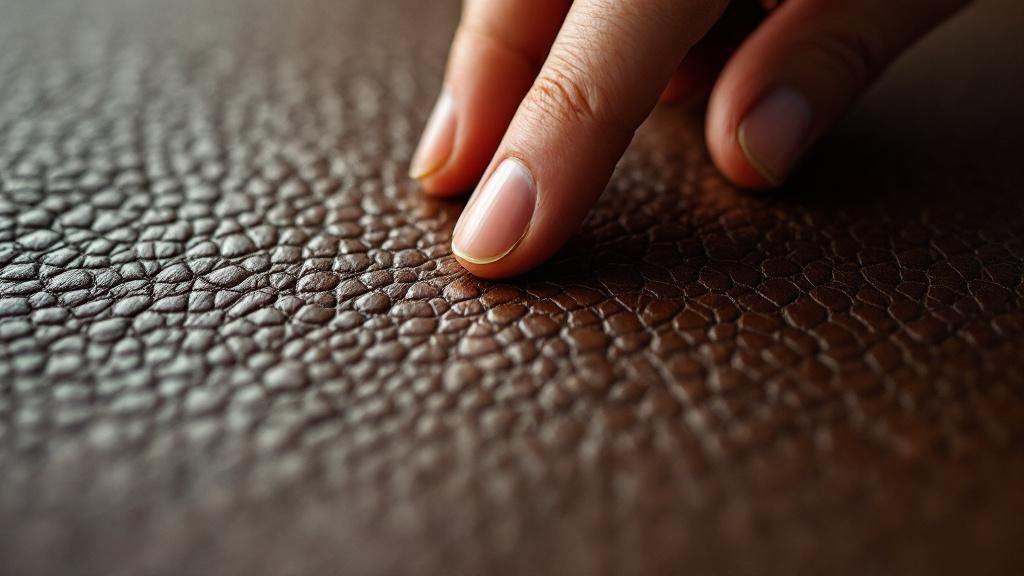
You can often tell real leather by its imperfections—genuine hides have unique, non-repeating grain patterns, small scars, and a rich, earthy smell. Synthetics, on the other hand, look and feel unnaturally uniform and often have a chemical or plastic-like odor. Pressing your finger into real leather will cause it to wrinkle naturally, not just dimple like plastic.
Why Knowing Real Leather Matters
Before we jump into the hands-on tests, let's talk about why telling real leather from a fake even matters. It's about so much more than just the price tag. When you learn to spot the difference, you're making a smart investment, appreciating true craftsmanship, and ultimately, getting the quality you pay for.
An authentic leather piece is a long-term companion. I've seen countless faux leather items that crack, peel, or tear after just a few years of use. Real leather, however, has a durability that stands the test of time. A well-made leather bag or jacket doesn't just last; it evolves with you.
Durability and Lasting Value
One of the most compelling reasons to choose real leather is its remarkable ability to develop a unique patina. This is the beautiful sheen and rich character that emerges on the surface over years of use, handling, and exposure to the elements. Every single scuff and crease tells a story, making the item uniquely and completely yours.
This aging process is a hallmark of quality that synthetics simply cannot replicate. A plastic-based material breaks down and loses its appeal, whereas real leather gains personality and value.
The global demand for high-quality leather goods reflects this enduring appeal. The market for leather luggage and goods was valued at around $295.4 billion and is projected to grow significantly. It’s clear this material has a timeless desirability that people are willing to invest in.
Making an Informed Purchase
Knowing how to spot genuine leather also empowers you as a consumer. It's your best defense against counterfeit goods and misleading "genuine imitation" labels. By authenticating your purchase, you're not just buying a product; you're investing in its inherent benefits:
- Superior Comfort: Real leather is a natural, breathable material. It adapts to its environment and your body, making it far more comfortable to wear or use over time.
- Timeless Style: A genuine leather piece is a cornerstone of any quality wardrobe. To see how these items fit into a lasting collection, check out our guide on building a classic wardrobe.
- Supporting Craftsmanship: Choosing real leather often means you're supporting skilled artisans and traditional tanning processes, helping preserve heritage skills that have been passed down for generations.
Ultimately, identifying real leather ensures you bring home a product that offers lasting function, timeless style, and a story that grows right along with you.
The Hands-On Inspection: Look and Feel
When you're trying to figure out if that jacket or sofa is the real deal, your own senses are the best tools you have right out of the gate. Long before you need to get into any fancy tests, a careful hands-on inspection, combining what you see and what you feel, can tell you almost everything you need to know.
Let's walk through what you should be looking for.
Start by giving the item a really close look. Real leather comes from an animal hide, and just like skin, it's not perfect. It has character. You should be able to spot small, randomly scattered pores, maybe a few tiny scars, or some subtle wrinkles on the surface. These aren't flaws—they're the hallmarks of authenticity.
On the flip side, synthetic materials are cranked out by machines, designed for absolute uniformity. If you notice a grain pattern that looks a bit too perfect or repeats itself over and over, you're almost certainly looking at faux leather.
Examine the Surface Grain and Texture
The grain of the material is one of the most revealing clues. Genuine leather has a natural, sometimes slightly uneven grain that gives it a unique, beautiful character. Synthetic leathers, because they're machine-made, will have a much more uniform, almost printed-on pattern.
This skill of spotting natural, unique markers in a material is valuable in other areas, too. It’s a similar principle used when you’re learning how to identify antique furniture, where telling aged, authentic leather from a newer imitation is a crucial skill.
The All-Important Touch Test
Okay, now it’s time to actually feel the material. Run your hand across the surface. Genuine leather usually feels soft and flexible, with a natural warmth to it. It shouldn't feel perfectly smooth like a sheet of plastic; you want to feel a subtle, fine-grained texture under your fingertips.
Next, gently press your finger into the leather. This is a great little test.
- Real Leather: It will wrinkle and gather under the pressure, a lot like your own skin does. When you let go, those wrinkles will slowly smooth back out.
- Faux Leather: It will typically just dimple under your finger, indenting without creating those fine wrinkles. It often feels colder to the touch and more rigid.
This image really captures how that simple press test can reveal the material's natural give and softness.
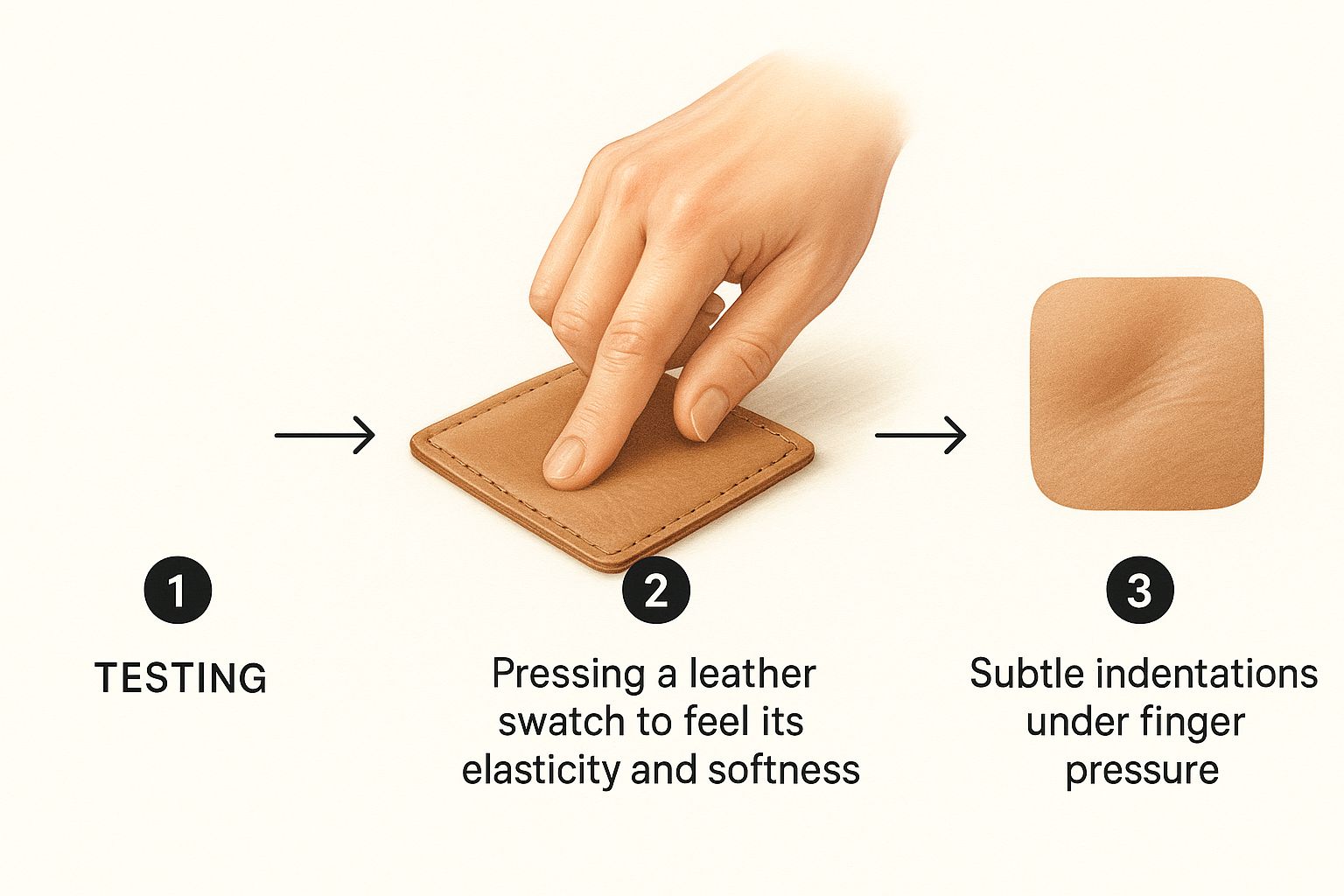
You can see the natural elasticity of a real hide, a quality that synthetic materials have a tough time replicating convincingly.
A quick side-by-side comparison can make these differences even clearer.
Real vs Fake Leather: A Visual and Touch Comparison
This table breaks down the key tactile and visual cues that separate a genuine hide from a synthetic look-alike. Keep these in mind the next time you're inspecting a potential leather purchase.
| Characteristic | Real Leather | Faux or PU Leather |
|---|---|---|
| Surface Grain | Irregular, unique, with natural imperfections. | Repetitive, uniform, machine-made pattern. |
| Texture | Soft, supple, with a fine, grainy feel. | Smooth, cold, often feels like plastic. |
| Pores | Small, visible, and randomly spaced. | No visible pores or a very uniform pattern. |
| Edges | Rough, fibrous, and slightly frayed. | Smooth, perfect, and uniform. |
| Flexibility | Wrinkles under pressure, like skin. | Dimples or indents, but doesn't wrinkle. |
| Warmth | Feels naturally warm and breathable. | Often feels cool and less "alive." |
Trusting your senses is often the most reliable way to make a quick assessment. These are the details that machines just can't fake.
Don't forget to check the edges if you can see them, like on the strap of a handbag or the edge of a belt. A real piece of leather will have a rough, almost fibrous look where the hide was cut. Faux leather is basically a layer of plastic bonded to fabric, so its edge will be perfectly smooth and clean—a dead giveaway that it was manufactured.
Trusting Your Sense of Smell
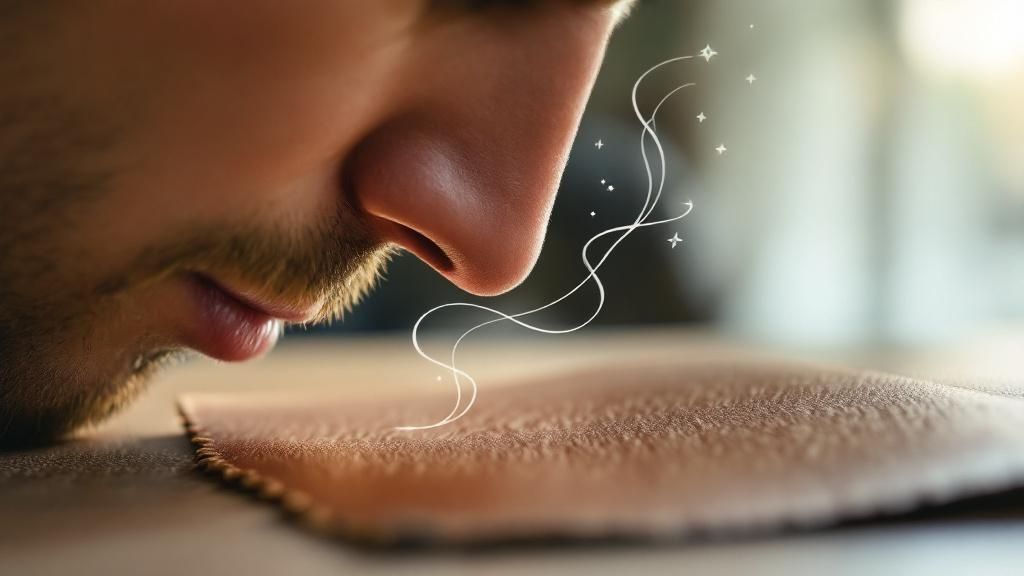
After you’ve given an item a good look and feel, it’s time to bring in another one of your most powerful tools: your nose. This might sound a little strange, but the smell test is one of the quickest and most telling ways to distinguish real leather from fakes. The authentic aroma of genuine leather is incredibly difficult to replicate convincingly.
Real, high-quality leather has an unmistakable scent. It’s often described as rich, deep, and slightly earthy—a natural fragrance that comes from the hide itself and the traditional tanning processes it goes through. It’s an organic, warm smell that speaks of craftsmanship and nature.
In stark contrast, faux leather, which is just a fancy term for plastic-based materials like polyurethane (PU) or polyvinyl chloride (PVC), usually gives off a very different vibe. You’ll often get hit with a sharp, chemical odor or that distinct smell of plastic. Even on a brand-new product, that synthetic aroma is a dead giveaway.
What to Sniff For
When you bring the item close for a sniff, try to tune out any surface-level scents like conditioners or store perfumes. What you're after is the inherent smell of the material itself.
- Real Leather Scents: You're looking for earthy, almost oaky or woodsy notes. It should smell natural and alive, never artificial.
- Faux Leather Scents: Be on high alert for anything that smells like chemicals, plastic, or has a faint vinyl tang. Some of the more expensive fakes might not have a strong smell at all, but they will never possess that rich, organic scent of a genuine hide.
Honestly, this is a skill you get better at with experience. The more you consciously smell different bags, jackets, and shoes, the quicker you'll be able to identify the real deal by its aroma alone. It’s a subtle but incredibly effective trick to have up your sleeve.
My personal tip for doing this in a store is to be discreet. You don't need to make a big production out of it. Just lift the corner of a bag or the collar of a jacket towards your face, as if you're inspecting the stitching up close. This lets you get a good, solid whiff without attracting any unwanted attention.
The Problem with Scented Fakes
Now, some manufacturers know their products smell like a chemical plant, so they try to cover it up. They'll spray on artificial fragrances designed to mimic the scent of real leather. Don't be fooled. These attempts almost always miss the mark. The scent usually comes across as overly sweet, one-dimensional, or almost perfume-like, completely lacking the deep, complex notes of a properly tanned hide.
If a "leather" scent seems way too strong or just smells a bit off, trust your gut. An authentic scent is an integral part of the material, not something sprayed on top like an air freshener. When you combine this simple smell test with your visual and touch checks, you build a much stronger, more confident assessment, ensuring you can tell a future heirloom from a cheap imitation.
Simple Home Tests for Confirmation
When your senses leave you wanting a bit more certainty, a couple of simple home-based tests can help you tell real leather from its synthetic counterparts. These methods are more definitive than just looking or smelling, but they do require some caution. It's absolutely crucial to perform these tests only on an inconspicuous area of the item, like the underside of a sofa cushion or the inside of a bag's pocket.
One of the most reliable methods is the water test. It’s incredibly simple and hinges on one of the key properties of a natural hide: its porosity. Real, untreated leather is a natural material that will absorb moisture.
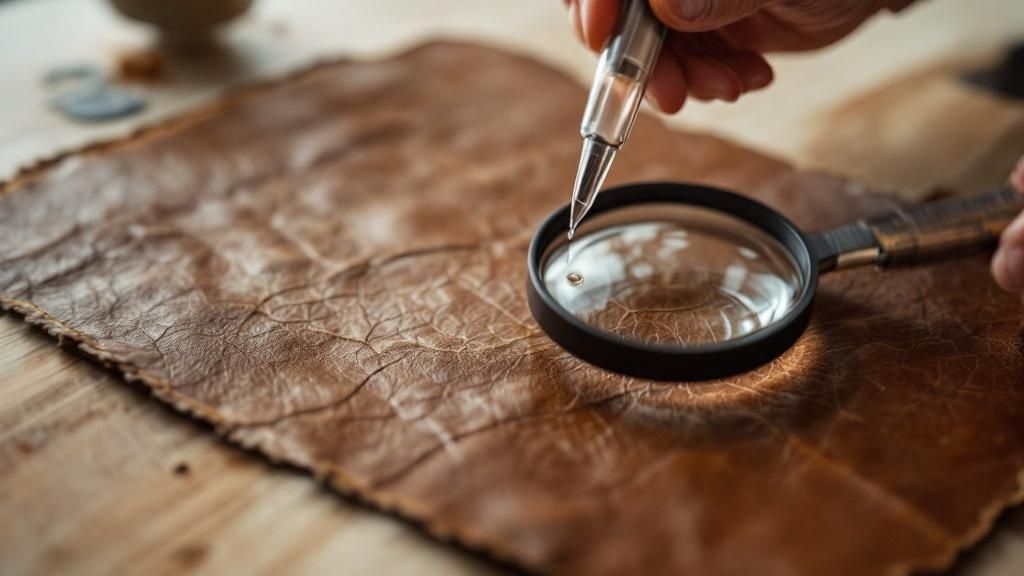
To try it out, just place a single small drop of water onto the surface. Now, watch what happens over the next few seconds. If it's real leather, you’ll see the drop slowly soak into the material, darkening the spot slightly as it’s absorbed. That’s exactly what you want to see.
On the other hand, if the material is fake, the water will likely just bead up and sit right on the surface. Faux leather is essentially plastic, which is non-porous and water-resistant, so the droplet will eventually just roll off without leaving a trace.
Key Takeaway: Real leather drinks water; faux leather repels it. This simple behavior is a powerful indicator of authenticity, revealing the natural properties of a genuine hide versus a man-made material.
A More Definitive Fire Test
If you’re still not convinced and are willing to take a bigger risk, the fire test offers a nearly foolproof answer. This test is inherently destructive and should only be performed with extreme caution on a hidden, non-visible spot that you are willing to potentially damage. I don't recommend this for items you can't afford to harm in any way.
You'll just need a long lighter or a match for this.
- First, find a very small, hidden area of the material. The ideal spot would be an excess seam allowance on the inside or the very underside of a piece of furniture.
- Carefully bring the tip of the flame close to the material for just 5 to 10 seconds. You aren't trying to set the item on fire, just observe how the material reacts to the heat.
- Pay close attention to what happens and what you smell.
The results are quite distinct and will tell you everything you need to know.
Interpreting the Results
The reaction to the flame is the ultimate clue. Real leather, being animal hide, behaves very differently to heat than a synthetic, plastic-based fabric does.
Here's what to look for:
- Real Leather Reaction: It will char slightly and may glow at the point of contact, but it won’t really catch fire and sustain a flame. Most importantly, it will give off a smell very similar to burnt hair—a distinct, organic scent you can't mistake.
- Faux Leather Reaction: This material will likely catch fire quickly and melt. You'll see it drip and curl just like melting plastic, because that's essentially what it is. The smell will be acrid and chemical, that unmistakable odor of burning plastic.
This test, while a last resort, provides pretty conclusive evidence. The way a material reacts to fire directly reflects its composition—natural animal hide versus a petroleum-based synthetic. By performing these tests carefully, you can move beyond suspicion to certainty and truly know what you've got.
Understanding Leather Grades and Labels
Just because an item is technically "real leather" doesn't mean it’s high quality. The world of leather has a clear hierarchy, and the terms you see on a label can be incredibly revealing—or intentionally misleading. Learning to decode these grades is how you move from simply asking, "is it real?" to the more important question, "is it any good?"
Not all leather is created equal. The term you see on the tag directly relates to which part of the animal hide was used and how it was processed. This, in turn, dictates the item's durability, appearance, and how it will age over time.
Think of an animal hide like a plank of wood. The top surface has the most character and strength, while the lower layers are less robust. Leather production often involves splitting this hide into different layers, which results in various grades of quality.
The Gold Standard: Full-Grain Leather
At the very top of the quality ladder sits full-grain leather. This is, simply put, the best you can get. It comes from the outermost layer of the hide and includes all of the natural grain, complete with its inherent imperfections like scars or pores.
Because the surface is left completely intact—it hasn't been sanded or buffed—full-grain leather is exceptionally strong and durable. Over time, it develops a rich patina, that beautiful sheen and character that makes aged leather so desirable. It tells a story and only gets better with use.
A Close Second: Top-Grain Leather
Just below full-grain is top-grain leather, which is still a very high-quality material. The key difference is that the very top layer of the hide has been lightly sanded or "corrected" to remove any significant imperfections.
This process makes the surface more uniform and often more stain-resistant, but it also removes some of the natural grain and reduces its breathability slightly. Top-grain is a fantastic choice for items that need to withstand a bit more wear and tear, like high-use furniture or handbags, as it often has a protective topcoat applied.
A key thing to remember: while top-grain is excellent, it won't develop the same deep, rich patina as full-grain because its natural surface has been altered. It essentially trades a bit of character for more consistency.
Where Labels Get Tricky: "Genuine Leather"
Here’s where things get confusing for most people. The term "Genuine Leather" sounds great, doesn't it? In reality, it's often used to describe one of the lowest grades of real leather.
Genuine leather is typically made from the inner or lower layers of the hide that are left after the top-grain has been split off. Its surface is then heavily processed—sanded, painted, and embossed with a leather-like grain to create a uniform appearance. While it is real leather, it lacks the strength, durability, and character of the higher grades.
Finally, at the bottom of the barrel, you have bonded leather. This isn't a solid hide at all. It's made from leftover leather scraps and fibers that are shredded, mixed with a bonding agent like polyurethane, and pressed onto a backing. It’s the particle board of the leather world—cheap to produce but prone to peeling and cracking very quickly.
When you’re dealing with high-value items or just have to be absolutely certain, it helps to know what’s on the horizon for leather verification. While the sensory and home tests we've covered are fantastic for day-to-day use, the real future of telling real leather from a fake is shifting toward precise, scientific methods. This is especially true in the luxury goods world, where authenticity is everything.
These advanced techniques go way beyond what you can see or feel, digging into the material at a molecular level. They deliver definitive, undeniable proof that protects both brands and buyers from increasingly sophisticated fakes. Their very existence shows how serious the industry is becoming about transparency.
Peeking Through the Microscope
One of the most established scientific methods is microscopic analysis. When you put a tiny sample of real leather under a powerful microscope, its organic origins become incredibly clear. You’ll see the unique, tangled, and completely random fibrous structure of an animal hide—a chaotic and natural pattern that’s simply impossible for a machine to replicate perfectly.
On the other hand, a synthetic material will look much more orderly, often showing a layered or woven construction. You might see a fabric base with a solid plastic layer coated on top. This stark structural difference offers conclusive evidence of a material's origin, making it a cornerstone of lab-based authentication.
DNA and Isotopic Fingerprinting
Now we're getting into some seriously advanced territory. There are emerging technologies that offer almost flawless validation, giving us a glimpse into where the world of authentication is headed.
The most exciting developments are in isotopic analysis and DNA barcoding. These tools act like a material's unique fingerprint, offering incredibly precise data about its geographic and biological origins. They analyze the chemical and genetic markers right inside the material to confirm not just that it's leather, but sometimes even the specific animal it came from.
This kind of tech is becoming more and more crucial for telling real materials from fakes. The entire authentication field is evolving with scientific tools like these, which are already being used successfully in other industries, like verifying organic cotton. To get a better sense of this broader trend, you can read about the latest in material authentication.
Of course, you won't be whipping out a DNA sequencer on your next shopping trip. But knowing these methods exist is still important. They are quickly becoming the gold standard for high-stakes verification, used by luxury brands and forensic experts to shut down counterfeiters. As these technologies get more affordable and accessible, they could one day give consumers an unprecedented level of confidence in the authenticity of their luxury purchases.
Got Questions About Telling Real Leather from Fakes?
Even after you've gotten a feel for what real leather looks, smells, and feels like, a few common questions always seem to surface right when you're about to make a purchase. Getting these sorted is often the final piece of the puzzle, giving you the confidence to know you're getting the real deal. Let's dig into some of the most frequent queries I hear from people trying to spot genuine leather.
Can the Price Tag Really Tell Me If It's Real Leather?
In most cases, yes—but don't rely on it alone. Producing genuine leather is a far more intensive and costly process than churning out synthetics, so a price that seems too good to be true is a massive red flag. That "leather" jacket on sale for $50? You can be almost certain it's a fake.
But here's the catch: savvy sellers of counterfeit goods sometimes inflate their prices to create a false sense of quality. Think of the price tag as a strong clue, not definitive proof. Always back it up with the touch, smell, and visual checks we've talked about. A high price doesn't guarantee real leather, but a rock-bottom one almost always signals a fake.
Does Real Leather Stretch Over Time?
Absolutely, and it's one of the most cherished qualities of a genuine hide. Real leather has a natural elasticity that lets it give and mold to your body with use. It's exactly why a great pair of leather shoes or gloves goes from stiff to unbelievably comfortable after you've worn them for a while.
The key is that it stretches and conforms without losing its core shape. Synthetics just don't have this quality. A thin faux leather might stretch a bit, but it won't mold to you in the same personalized way. In fact, it's far more likely to tear or crack if you push it too far. This unique ability to adapt is another one of those subtle, reliable signs that you're dealing with a genuine material.
This ability to adapt and evolve is a core benefit of authentic leather. It’s a material that works with you, creating a personalized fit that synthetics can't match.
Why Does Some Real Leather Look So Flawlessly Smooth?
When you see leather that looks almost too perfect, you're likely looking at what's called "corrected-grain" leather. It's still real leather, but the original hide had its share of natural marks—scars, insect bites, or other blemishes. To get that uniform, flawless look, the surface is buffed or sanded down to erase those imperfections.
After sanding, an artificial grain pattern is often stamped onto the surface to make it look natural again. This is a very common practice for products sold as "Top-Grain" leather and some items simply labeled "Genuine Leather." On the other hand, Full-Grain leather—the highest quality you can get—is celebrated precisely because its natural, uncorrected surface is left completely intact, showcasing all of its original character.
Is Vegan Leather a Good Alternative?
It's crucial to know that "vegan leather" is a marketing term, not a type of leather. It's a catch-all phrase for synthetic, man-made materials like polyurethane (PU) or polyvinyl chloride (PVC). By definition, it contains no animal products.
While it's a valid choice for anyone avoiding animal products for ethical reasons, it simply doesn't perform like a real hide. If you opt for vegan leather, you'll be giving up a few key benefits:
- Durability: It has a tendency to crack, peel, and delaminate over time, especially at flex points like elbows or corners.
- Breathability: Because it's essentially plastic, it doesn't breathe. This can make clothing or shoes feel clammy and uncomfortable.
- Aging: It will never develop that rich, beautiful patina that gives genuine leather so much character as it ages. It just gets old and worn out.
At the end of the day, it's an entirely different material with a different set of properties and a significantly shorter lifespan.
At Feinheit FZ LLC, we believe in the lasting value of authentic, high-quality materials. Explore our curated collection of luxury goods, where every piece is guaranteed to be the real deal, offering the timeless style and durability you deserve. Discover true refinement today.
