

Most clothing care advice starts too late. It tells you how to remove a stain, but not how to protect the garment before heat, detergent, friction, and storage erode its structure. If the piece matters to your rotation, clothing care tips should function like investment protection, because the cost is rarely the first purchase, it's the shortened life that follows careless laundering.
That's why the best routine is less about domestic housekeeping and more about disciplined ownership. Consumer washing and drying can account for about 20% of a garment's climate impact in a global life-cycle analysis cited by the apparel sector, so every unnecessary cycle has a real cost beyond the utility bill, and every extra year of wear lowers the impact per use (scienceinsights.org). For high-value wardrobes, that matters. Wool, silk, cashmere, and structured tailoring lose their shape and finish faster when they're treated like cotton basics.
The professional mindset is simple. Assess the fiber, match the water temperature, choose the right detergent, dry for structure, and store for stability. Everything else is detail.
1. Strategic Fabric Assessment Before Washing
A common mistake involves treating the label as decoration. A garment's fiber content, weave density, lining, interfacings, and trims tell you whether it can survive agitation or needs minimal handling. A silk scarf, a structured blazer, and a brushed cashmere knit all fail for different reasons, so the wash plan has to start with construction, not with habit.
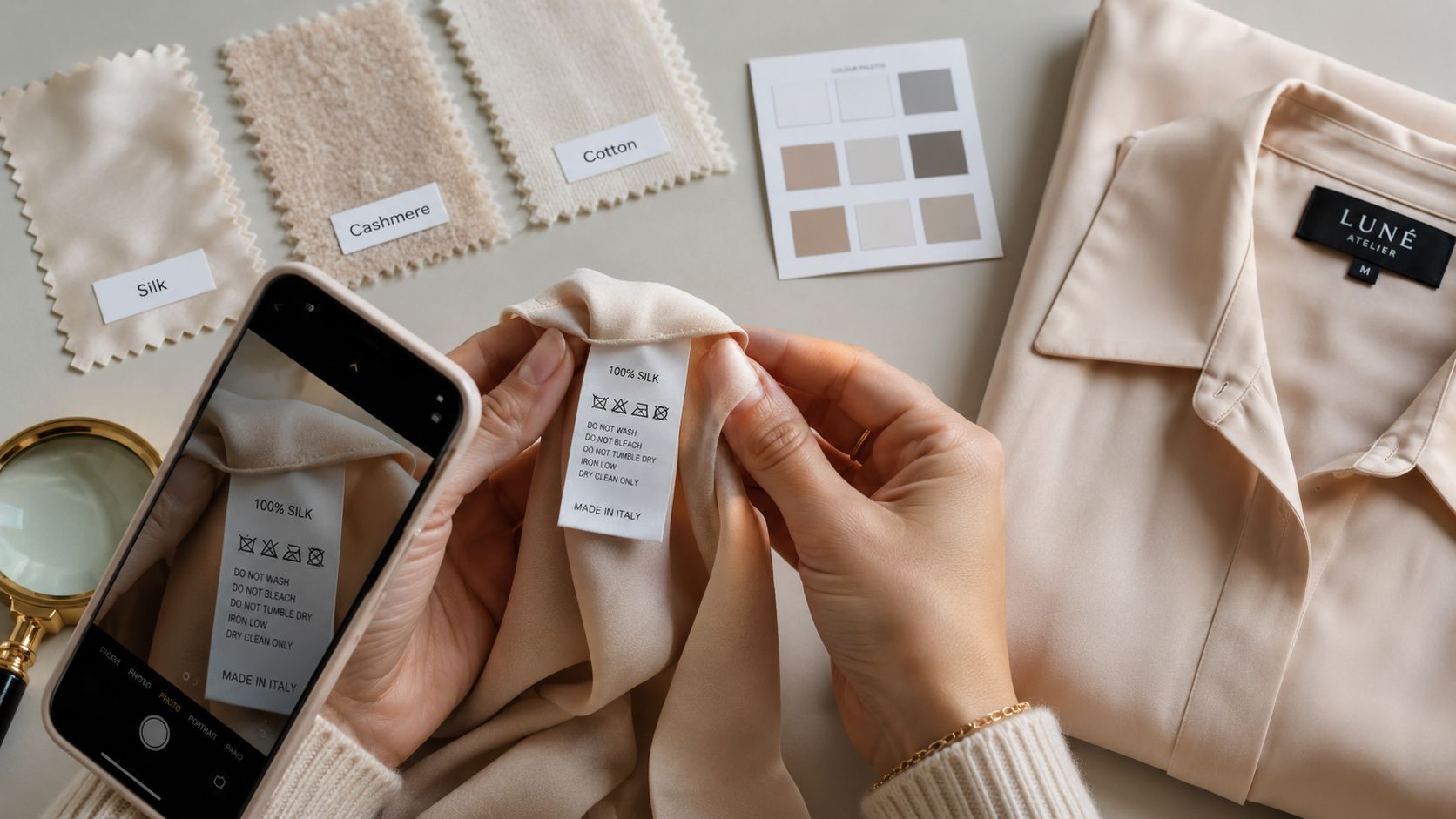
Read the garment the way a conservator would
ISO standardized care-symbol systems so garments can be cleaned consistently across markets, and that standardization exists for a reason, it reduces avoidable shrinkage, color loss, and fiber damage when you follow the manufacturer's instructions (lesswaste.org.uk). In practice, that means checking whether a piece carries structure that can warp under moisture, or a surface that can abrade under spin speed.
For valuable wardrobes, ownership confidence begins with these actions. Photograph the label before the first wash, keep a note of any trim, and mark which items need hand washing, flat drying, or professional cleaning. If a piece combines silk with lining or cashmere with tailoring, don't guess. Test an inconspicuous area first, then build your own garment record so you're not relearning the same lesson every season.
Practical rule: If the garment has shape, padding, or a surface finish you care about, read the label as a cleaning protocol, not as a suggestion.
Use reference points, not assumptions
Many people know a favorite scarf or knit by feel, but feel isn't enough. A Hermès silk scarf, for example, behaves differently from a plain silk blouse because the weave, print, and finishing all affect how the fabric tolerates moisture and agitation. Likewise, a cashmere knit and a structured wool jacket may both say “dry clean,” but they don't age the same way in storage or under pressure.
If you wear certain pieces often, create a simple care record. Note the fiber, the approved method, and any known weak points, like shoulder stretching, loose hems, or color bleed. That record becomes part of the wardrobe's infrastructure, and it saves you from repeating risky experiments on pieces that should have been protected from the start.
2. Temperature Control and Water Quality Management
Water temperature is one of the most consequential variables in laundry, and most damage starts there. Hot water pushes dyes to bleed, increases shrink risk, and accelerates fiber stress, while cold water helps preserve structure and color. That's why cold-water routines remain the default for garment preservation, and why experts also point to shorter cycles and low-intensity settings when machine washing can't be avoided (theguardian.com).
Think in terms of fiber behavior, not habit
A garment reacts to heat before it reacts to detergent. Wool tightens, silk loses composure, and darker fabrics show fading faster when the water is too warm. For denim, a long wash in hot water can flatten fades and distort the shape, while cold water with a gentle cycle helps protect the finish and reduce color loss.
Water quality matters too, especially in closets built around natural fibers. Hard water leaves mineral residue that can dull surfaces, interfere with detergent performance, and slowly make fabrics feel tired. Filtered or distilled water is a useful choice where mineral load is high, particularly for pieces you want to keep visually clean and soft to the touch. In a climate where water varies from one property to another, consistency is often more valuable than force.
A practical habit is to match the water temperature to the room temperature before you wash delicate pieces. That reduces shock to fibers that can stiffen or contract when moved from a hot environment straight into a cold bath, or the reverse. Keep the wash process controlled, and the garment has a better chance of coming back in the same shape you sent it in.
Cold water is not a compromise for valuable clothing. It's usually the safer starting point, and the burden shifts to detergent choice and cycle discipline.
Keep the cycle tight and predictable
Long cycles do more than consume time. They increase exposure to water, movement, and temperature fluctuation, which is exactly what delicate construction doesn't need. For items with structure, a maximum 60-minute wash is a sensible upper boundary when a machine has to be used, because the goal is removal, not saturation.
Pre-soaking can help, but only when it's cool and brief. It's a useful way to loosen soil without punishing the fibers before the main cycle starts. What doesn't help is stacking harsh temperature, long agitation, and overloaded drums on top of one another. That combination is how a garment loses its finish before it ever leaves the washer.
3. Detergent Selection Based on Fiber Type
Detergent is where a lot of good garments go wrong. Standard formulas are built for volume laundry, not for preserving the molecular structure of wool, silk, cashmere, or blend fabrics with delicate finishes. The difference isn't subtle. A detergent that cleans aggressively can also strip softness, leave residue, or compromise the surface you were trying to protect.
Match the chemistry to the fabric
The label on the bottle matters less than the fiber in the garment. Wool does best with neutral pH formulations that respect its natural properties. Silk benefits from a silk-specific cleaner, while cashmere usually responds better to formulations that keep the hand soft rather than overly stripped. Blend pieces demand more caution, because the wrong formula may suit one component and damage another.
Expert laundry guidance also notes that two tablespoons of detergent is often enough for a large load, and that overloading or using too much detergent can leave residue that dulls finishes and traps odors (lesswaste.org.uk). That matters in premium wardrobes, where residue is not just an aesthetic issue, it can alter hand feel and make a garment look tired long before it should.
For pieces with mixed fibers, start small. Use a lower dosage than you think you need, then judge the result after the first rinse. If the fabric feels coated, the problem is usually not under-cleaning, it's overuse.
Build a tiny detergent library
You don't need a shelf full of products, but you do need the right few. Keep separate formulas for wool, silk, and general delicate washing, and label them clearly so the wrong bottle doesn't get used in a hurry. On blend pieces, think in terms of compatibility rather than one universal solution.
Practical rule: If a garment is expensive because of its fiber or finish, don't trust a one-size-fits-all detergent to protect it.
A smart routine also includes a second rinse when residue is a concern. The point is to clear the fiber fully, not to leave cleaner behind as a film. That's especially relevant after washing dark or lustrous fabrics, where leftover surfactant can flatten the surface and make the piece look older than it is.
4. Drying Protocols Preventing Structural Compromise
Drying determines whether a garment returns to its intended shape or develops permanent distortion. Heat and tumbling are efficient at removing water, but they're also efficient at stressing seams, stretching necklines, and weakening elastic recovery. For structured pieces, air drying isn't a softer option, it's the method that protects construction.
Let the fibers settle naturally
The biggest advantage of air drying is that it allows a garment to recover without mechanical force. Knitwear holds its shape better when it dries flat, because gravity stops acting on a wet shoulder or hem. Dress trousers and silk blouses also fare better when they're supported during drying instead of being left to distort under their own weight.
A useful example is denim care. Levi's recommends air drying, inside out, to protect fit and color, and to avoid the shrinkage and damage that dryers can cause (Levi's denim guide). That logic extends beyond jeans. If a textile has a silhouette worth preserving, the dryer should be a last resort, not a default.
Reshaping while damp is another small move that pays off. Fibers accept form more readily before they're fully dry, so align hems, smooth seams, and flatten edges before the garment sets. That's basic blocking logic, and it's especially useful for fine knits and bias-cut pieces.
Dry with enough air, not enough heat
Drying racks are more important than often perceived. If air can circulate around the garment, moisture leaves more evenly and mildew risk drops. Avoid humid rooms, because damp air extends drying time and can leave fabric with a stale, compressed smell. For sweaters, roll in a towel first to remove excess water, then dry flat on a rack or clean surface.
Air drying is not just an environmental preference. It's a preservation method for pieces whose shape you actually want to keep.
For high-value knitwear, the priority is shape integrity. For silk and structured tailoring, the priority is controlled evaporation without stress points. Once you understand that, the logic becomes clear. You're not drying clothing, you're stabilizing it.
5. Storage Environment Design for Long-Term Preservation
Storage is where many wardrobes lose value without any visible drama. Heat cycles, humidity swings, dust, and light work slowly, and by the time the change is obvious, the piece has already lost some of its original condition. Professional-grade storage treats the closet as a controlled environment, because the conditions around the garment are part of the garment's total care and its retained value.
Control the environment before it controls the fabric
Clothing keeps its structure better in cool, dry, ventilated spaces. Humidity encourages mold and mildew, while excess dryness can make some materials feel brittle over time. Light exposure fades color gradually, so items left in direct sun near a window will age faster than pieces kept in a shaded, stable space.
The higher the value of the fiber, the stricter the storage standard should be. Heavy knits should be folded rather than hung, because hanging distorts shoulders and stretches the body over time. Structured pieces benefit from shaped hangers that support the shoulder line. If you want the piece to keep its proportion, the hanger has to respect the construction.
Use breathable storage for off-season items, and avoid packing everything into plastic where moisture can get trapped. Acid-free paper can reduce direct contact with wood surfaces, while cedar blocks add a traditional layer of insect deterrence in enclosed storage. If you've ever opened a box and found a stale odor or a crushed neckline, you already know how costly poor storage can become. For garments and accessories that need steadier conditions during transport or temporary holding, secure storage for your move is the same principle applied outside the closet.
Build storage around the garment calendar
Season-off storage should be clean, dry, and documented. Photograph pieces before packing them away, note any loose seams or pilling, and keep the box labeled so you're not reopening everything later. If a sweater is folded in the wrong place for months, that crease becomes part of the story.
The storage system should match the piece, not the other way around. Fine knits need flat storage with minimal pressure points, while garments like blazers and suits need room to hold their line. Shoes, bags, and similar items also hold their condition better when they are stored with support, cleaned before packing, and kept away from fluctuating heat. That kind of discipline is part of better wardrobe preservation, not an afterthought.
Practical owners treat storage as a financial control point. A garment that keeps its shape, finish, and surface quality spends less time needing repair and more time in rotation. Stable conditions protect the material, the finish, and the fit.
6. Professional Cleaning Timing and Method Selection
Professional cleaning should be timed, not overused. Too frequent, and delicate fibers lose life through unnecessary processing. Too infrequent, and soil, body oils, and atmospheric grime settle into the fabric and become harder to remove cleanly. The smart move is to treat professional cleaning as a scheduled part of ownership, not as a rescue operation after damage has already spread.
Choose the method that fits the material
Dry cleaning is not a universal answer. Wet cleaning, hand finishing, pressing, and specialty treatments all have a place, depending on the garment and its construction. Structured jackets, suede, and leather accessories often need specific handling, while some delicate items hold up better with careful wet treatment than with repeated solvent exposure.
The timing matters just as much as the method. Seasonal service makes sense for pieces worn in rotation, especially if you want to preserve shoulder structure, nap, or surface sheen. If a cleaner can explain how they treat your exact fabric type, that's a stronger sign than a generic promise of “gentle care.”
For a leather bag, conditioning on a sensible seasonal schedule helps maintain suppleness and patina. For structured garments, pressing can restore line and authority without over-washing the body of the fabric. The goal is to maintain the piece's original intent, not to make it smell newly cleaned at the expense of its structure.
Ask better questions before you hand over the garment
The best cleaners can explain fiber-specific methods in plain language. Ask how they handle your fabric type, whether they separate by material, and how they prevent surface damage during finishing. If they can't answer clearly, the cost of a bad clean will exceed the price of the service.
Spot-treating at home can delay a full clean, but only if you intervene immediately and with restraint. That keeps soil from setting and reduces how often the garment has to go through a full process. Think of it as preserving your options, not avoiding cleaning altogether.
7. Stain Prevention and Immediate Response Protocols
Stain management is less about heroics and more about timing. Once a spill has oxidized or bonded into the fiber, your options narrow fast. The strongest protocol is prevention, followed by immediate, careful response. That combination protects both the appearance of the garment and its long-term value.
Prevent the stain before it lands
Some fabrics benefit from protective treatment before first wear, especially light-colored or delicate pieces that see regular use. A good protectant creates a barrier that slows absorption, which buys you time when an accident happens. That matters for handbags, scarves, suede, and pale knits that can be marked by water, oil, or pigment with very little warning.
Immediate response is the other half of the equation. Fresh stains are far easier to lift than old ones, because the material hasn't had time to set. Blot, don't rub, and use distilled water when possible so you're not adding mineral residue to the stain itself. Keep clean white cloths on hand, because colored towels can transfer dye when the situation is already messy.
Practical rule: Treat the first 24 hours as the window that protects the garment from turning a spill into permanent evidence.
Leather deserves a separate approach. Preventative conditioning can help the surface develop patina rather than blotchy staining, provided the product is appropriate for the leather type. On silk and cashmere, a measured response matters even more. Too much liquid, too much pressure, or the wrong cleaner can enlarge the problem.
Document the damage if you need help
Photograph the stain before you treat it. That gives a cleaner context about the spread, the color, and the location. It also helps if you need to explain what caused the mark, whether it was wine, oil, makeup, or ink.
For more specialized stain handling, a resource like InchBug's stain solutions can be useful when you're dealing with a specific type of spill, but the discipline stays the same. Fast response, minimal agitation, and the right solvent order are what keep the piece wearable.
8. Seasonal Care Routines and Off-Season Maintenance
Seasonal turnover is the right point to protect the pieces that are not in weekly use. It creates a clean break to inspect seams, remove accumulated soil, check hardware, and reset storage conditions before temperature swings and humidity start working on the fabric. Handle that window well, and the wardrobe holds value instead of slipping into avoidable decline.
Clean before storage, not after regret
Winter coats should be cleaned before they go into storage, especially if they have picked up road salt, moisture, or city grime. Salt does not stop affecting the fabric just because the weather changes. If it remains on the garment, the residue can keep breaking down fibers, and the next time you pull the coat out, the damage may already be set.
Seasonal maintenance also gives you a chance to catch pilling, loose stitching, and worn buttons before they turn into larger repairs. A quick inspection while items are still in rotation is far easier than finding a problem the night before you need the piece again. For knits, use a pilling tool with restraint, then store them with moth deterrents in a clean, dry box. If you need to keep fabrics fresh between wears or before storage, a tool like keep fabrics fresh can help maintain a cleaner finish without unnecessary handling.
Make seasonal care part of the ownership cycle
Rotate stored items every few months so one fold line does not settle in permanently. Refresh cedar blocks or lavender sachets as needed, and keep the storage area away from exterior walls where temperature swings are sharper. In climates with larger humidity shifts, that discipline matters more because moisture movement affects both shape retention and odor control.
A garment does not need constant attention, but it does need predictable attention. Seasonal care should change with the calendar. That is how you protect shape, finish, and resale confidence over time.
8-Point Clothing Care Comparison
| Item | Implementation complexity | Resource requirements | Expected outcomes | Ideal use cases | Key advantages |
|---|---|---|---|---|---|
| Strategic Fabric Assessment Before Washing | Low–Medium, requires knowledge of labels and construction | Minimal: time, label reading tools (camera, swatches) | Correct cleaning method selection; fewer wash-related failures | First wash of designer/mixed-fiber garments | Prevents irreversible damage; extends garment lifespan |
| Temperature Control and Water Quality Management | Medium, requires protocol discipline and testing | Water filters/distillers, temperature-capable equipment, enzyme detergents | Reduced dye bleed, shrinkage, and fiber stress | Delicate dyes, premium knits, color-sensitive pieces | Preserves color and structure; lowers long-term wear costs |
| Detergent Selection Based on Fiber Type | Medium, requires product knowledge and inventory | Multiple fiber-specific detergents; testing supplies | Preserved hand-feel and elasticity; less residue | Wool, silk, cashmere, and blend garments | Minimizes molecular damage; maintains professional finish |
| Drying Protocols Preventing Structural Compromise | Medium, needs space and careful handling | Drying racks, blocking forms, humidity control (optional) | Maintained shape and fit; reduced heat damage | Knitwear, structured garments, tailored pieces | Prevents stretching/distortion; preserves silhouette |
| Storage Environment Design for Long-Term Preservation | High, requires planning and infrastructure | Climate control (humidifier/dehumidifier), acid-free materials, space | Slower degradation, prevented mold/insect damage, stable appearance | Off-season storage and long-term-held investment pieces | Extends usable life; prevents silent environmental damage |
| Professional Cleaning Timing and Method Selection | Medium, needs schedule and vendor vetting | Budget for professional services; documentation of protocols | Targeted removal of soils/stains without overprocessing | Seasonal service for tailored, exotic, or structured items | Expert restoration and finishing; correct method selection |
| Stain Prevention and Immediate Response Protocols | Low–Medium, needs routine and quick action | Fabric protectants, blotting cloths, fiber-specific solvents | Greater stain removal success; fewer permanent marks | New pieces, light colors, high-risk events | Reduces likelihood and impact of stains; preserves appearance |
| Seasonal Care Routines and Off-Season Maintenance | Medium, requires recurring scheduling | Storage materials, conditioning products, inspection tools | Fewer seasonal failures; maintained hardware and finishes | Seasonal wardrobe rotation; leather and knit collections | Prevents accumulation damage; catches issues early |
Multiply Your Options Through Strategic Ownership
The best clothing care tips are rarely glamorous, but they're decisive. They protect fiber integrity, preserve construction, and extend the life of the pieces that do the essential work in a wardrobe. That's the difference between owning clothing and maintaining wardrobe infrastructure.
At theFeinheit, luxury is about finding pieces that multiply your options, not consume your budget. One strategic investment beats five impulse purchases. Explore our collection of over 13,000 products from 160+ leading brands to build wardrobe infrastructure that endures. Discover your power at theFeinheit.
Feinheit FZ LLC helps you choose pieces with the same discipline you should use to care for them, with an emphasis on authenticity, craftsmanship, and ownership confidence. Visit Feinheit FZ LLC to explore refined fashion that supports long-term value, then bring that same standard back to every wash, dry, and storage decision you make.