
Designer accessories are often purchased backwards. A favorite bag, ring, or pair of sunglasses is selected first, then forced into a wardrobe it was never built to serve. This results in beautiful objects that photograph well once and then disappear into storage.
The smarter move is harsher and more useful. Start with the wardrobe you wear, the five or ten looks that repeat every week, then choose the accessory that multiplies those outfits instead of completing just one. How to Choose the Right Designer Accessories for Any Outfit becomes much simpler when you stop shopping for the fantasy outfit and start shopping for the life you already live.
Why Most People Choose Accessories Backwards
The smarter starting point is the wardrobe you already wear. A client with five strong blazers and no reliable bag does not need another pretty object, she needs one accessory that works across work, dinner, and travel without feeling out of place. That is the test. Choose for repeat use, not for the outfit you hope to wear someday.
A well-dressed person does not need a drawer full of accessories. She needs the right piece in the right category, chosen to pull weight across the looks she repeats every week. Accessories are not finishing touches, they are wardrobe tools, and the market scale reflects that reality. Analysts at Grand View Research estimated the global fashion accessories market at USD 798.81 billion in 2024 and projected it to reach USD 1,259.43 billion by 2030. They also reported that jewelry held 48.4% revenue share in 2023 and women represented 52.5% of end-use demand.
The Hidden Cost of a One-Off Purchase
A one-off purchase is expensive in a way that is easy to miss. Mintel's UK data shows how buying behavior gets pulled toward occasions and promotions, not long-term use. Handbags were the largest share of the UK fashion accessories category at £1.2 billion, and 51% of UK women, about 13.5 million people, bought at least one handbag that year (Mintel). Mintel also found that 43% bought a new bag because of a special occasion, while 59% were motivated by sales and special offers. That is buying pressure, not styling logic.
Those numbers explain why so many accessories look right at checkout and wrong in real life. They were chosen for the moment of purchase, not for the weekday wardrobe that has to carry them. A client who only reaches for a bag with one dress, one event, or one mood has bought decoration, not a useful piece.
Practical rule: if a piece only works with one dress, one event, or one mood, it is decorative, not strategic.
Start with the five or more looks already hanging in your closet. If the accessory does not improve those outfits, it does not deserve space in your rotation. That is the test that keeps luxury spending from turning into expensive clutter.
How Chloe's signature bohemian style elements shape a look
Reading the Outfit Before You Touch the Jewelry Box
Start with the clothing, not the accessory. Every strong choice comes from three variables, silhouette, color palette, and occasion. If you ignore those, you get scale clashes, awkward contrast, or a look that feels accidentally overdone. If you read them first, the rest gets easy.
Silhouette decides the accessory scale
Structured tailoring can carry more presence than airy knitwear. A narrow neckline asks for different jewelry than an open collar. Delicate fabrics usually need quieter pieces, while heavier cloth can support bolder shapes without collapsing visually.
The technical rule is simple, and it matters more than people admit. Match accessory volume to outfit volume. A chunky bracelet against a thin silk top looks like it walked in from another outfit. A refined chain or slim cuff settles into the look and keeps the eye moving.
A camel office suit is the perfect example. It already has shape, authority, and clarity, so the accessory should sharpen that, not compete with it. Think a structured bag, restrained earrings, and one clean metal family. A black silk slip dress sits at the opposite end. It needs one focal piece, maybe a stronger earring or a more decisive necklace, while everything else recedes so the dress keeps its line.
The logic is not about adding more. It's about controlling where the eye lands first.
Practical rule: choose one hero piece, then make everything else quieter.
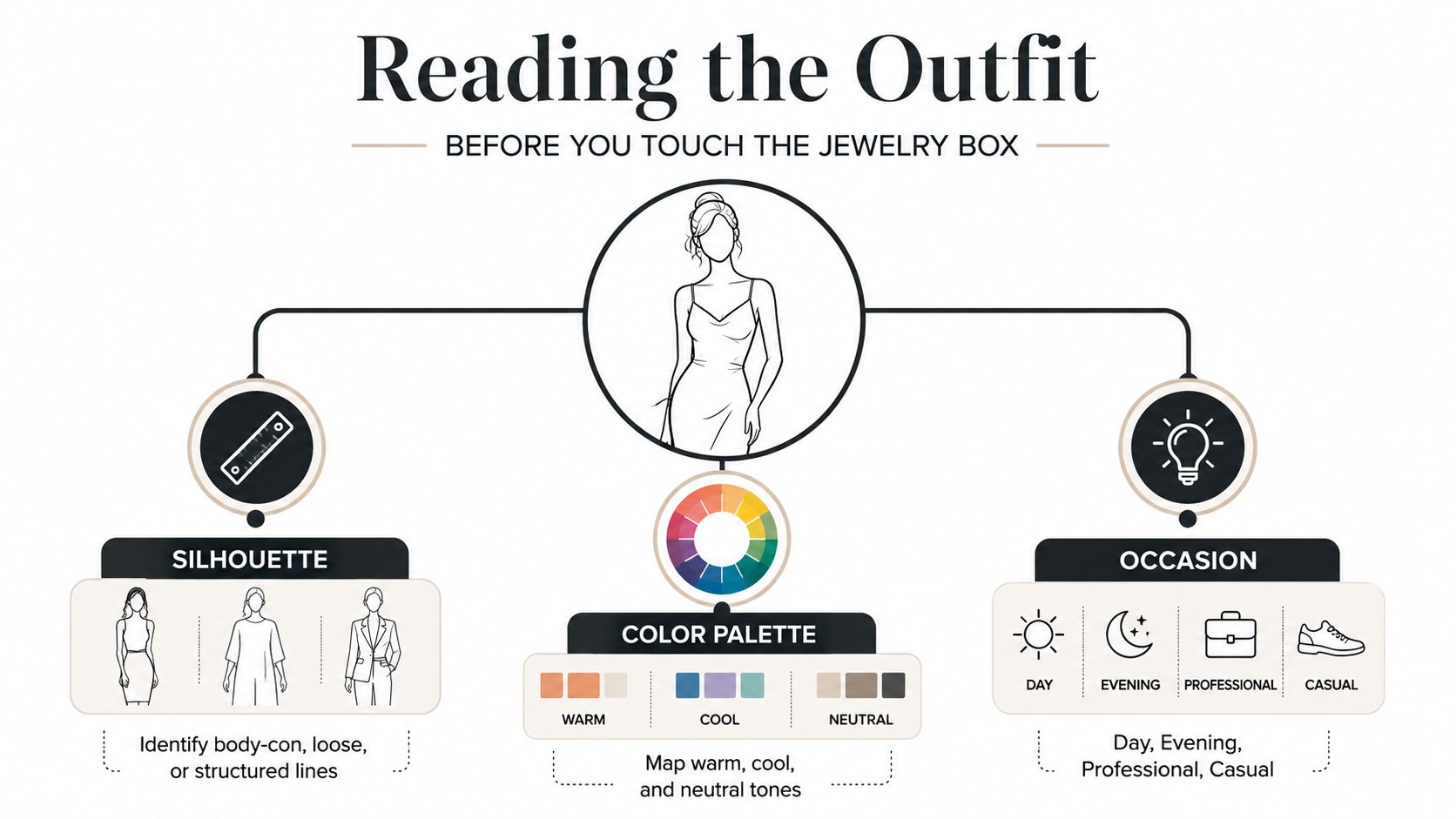
Color and occasion narrow the field fast
Color should confirm the outfit, not fight it. Warm camel with deep black reads differently from cool grey with navy. Occasion does the final sorting. Office wear asks for less noise, eveningwear can carry more gloss, and travel needs pieces that survive repetition without looking tired.
The common error is choosing accessories before the event context is clear. A bag that looks sharp at dinner can feel too theatrical on a Tuesday morning. A necklace that feels just right for an evening dress can overwhelm a professional jacket. Once you assign the outfit its place in the week, the right category usually reveals itself immediately.
If you want a sharp visual reminder of this process, use the process flow in the infographic and move through silhouette, color, then occasion in that order.
Match, Clash, or Break the Outfit on Purpose
Matching is the safest path, and sometimes that's exactly the point. In a boardroom, or in a setting where professional authority matters more than flair, coordinated accessories can read polished and controlled. A black shoe, black belt, and black bag still have their place. They just aren't the whole story anymore.
Controlled contrast does more work. A structured bag against softer fabric gives the outfit backbone. A polished metal watch with relaxed tailoring keeps the look from drifting. The key is that one element should lead while the others support, not all compete at once.
Three ways to handle the relationship
A match-set approach works best when you want quiet confidence. Think heritage-driven dressing, formal meetings, or any situation where you want the outfit to disappear behind your competence. It's not boring when it's deliberate.
A clash, handled well, adds energy. One unexpected color accent, or one material that interrupts the outfit's mood in a clean way, can make a quiet-luxury look feel more personal. That's especially useful when the base outfit is tonal and risk-averse.
A purposeful break is the most editorial option. It says you know the rules and you're using them selectively. That could mean a structured bag with a fluid dress, or one vivid accent in an otherwise restrained palette.
The mistake isn't contrast. The mistake is contrast without control.
For a more personal, style-led reference point, the way Chloé's signature bohemian style elements mix softness and shape is a useful example of contrast handled with intent. The point isn't to imitate a house aesthetic. It's to understand that contrast can look refined when the proportions are disciplined.
Use the setting to choose your lane
Workwear usually rewards matching or quiet contrast. Eveningwear can handle a deliberate break because the outfit already has permission to be more expressive. Travel sits in the middle, where repeat wear matters and extreme coordination becomes tiring fast.
The decision rule is blunt. If the outfit needs authority, match. If it needs interest, contrast. If it needs personality, break one rule on purpose and keep the rest disciplined.
Applying the 60-30-10 Color Logic to Accessories
The 60-30-10 rule is useful because it stops accessories from wandering all over the outfit. The main garment or group of garments carries the dominant color, the secondary tone supports it, and the accessory slot becomes the accent. That gives the eye a path instead of a fight.
Think of it as a hierarchy, not a formula for sameness. 60% is the foundation, 30% supports it, and 10% is where the accessory earns its impact. In fashion terms, that often means the bag, scarf, jewelry, or sunglasses hold the accent role rather than trying to own the whole outfit.
A worked example that actually makes sense
A navy suit, camel coat, and burgundy leather bag work because each piece has a job. Navy grounds the look. Camel softens it. Burgundy supplies the accent and keeps the palette from becoming flat.
Now compare that with a navy suit, navy bag, and camel coat. It's not wrong, but it can go dead quickly because the visual rhythm disappears. There's too much sameness and not enough lift. The outfit is coherent, but it doesn't breathe.
That's why accessories should often be the accent, not the echo. A strong bag color or a piece of jewelry with warmth can make a neutral wardrobe feel intentional instead of repetitive.
When to break the 60-30-10 rule
Break it when the accessory is the centerpiece and the outfit should step back. A singular designer bag can carry the entire look if the clothing is supportive. In that case, don't fight the piece by adding more color accents everywhere else.
A good example is a statement ring or a singular metal accent in an otherwise quiet outfit. For a resource on one such detail, a sterling silver gold accent ring shows how one piece can carry presence without requiring a busy outfit around it. The accessory should sharpen the look, not compete with it.
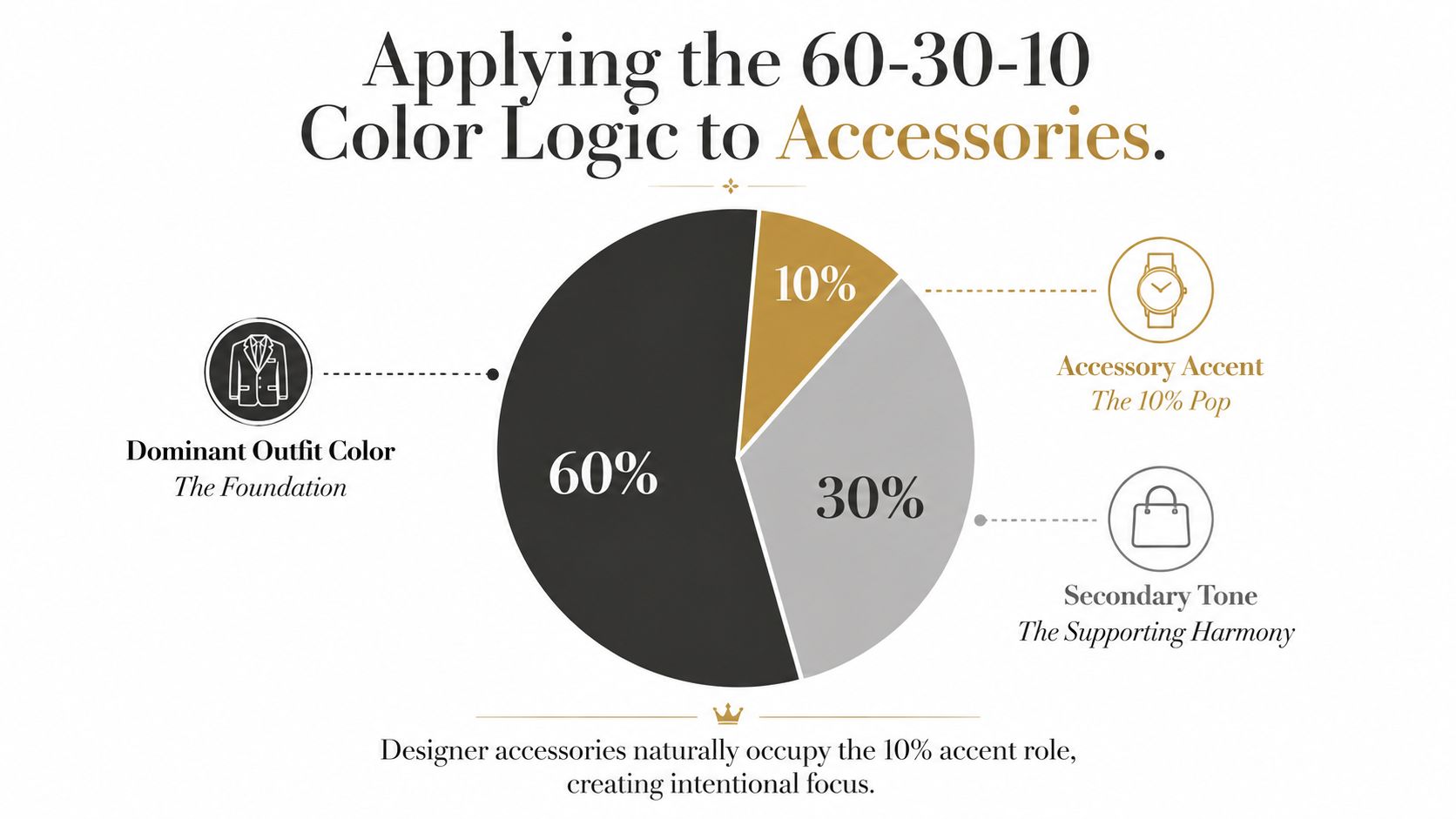
When you're deciding between two options, ask which one occupies the 10% accent role in your outfit. If neither does, the palette is probably overloaded.
The Cost-Per-Wear Test for Every Designer Piece
A designer accessory earns its place by how often you reach for it, not by how impressive it looks on first glance. That is the part most shoppers miss. They buy for the fantasy outfit, then wonder why the piece sits unused. Cost-per-wear cuts through that mistake because it measures the purchase against actual repetition.
Use the plain formula, total cost divided by number of wears. A modest piece that gets heavy rotation can outperform something far pricier that leaves the box only once in a while. The calculation only works if you tie it to the wardrobe you already live in, not the one you wish you had.
Two purchases, two very different outcomes
A $300 leather belt worn every week for five years stops feeling expensive quickly. Repetition spreads the cost, and the belt becomes part of the system. A $900 statement necklace worn twice stays a special object, even if it is beautiful.
That difference matters because a lot of people buy the wrong kind of drama. They respond to visual excitement and ignore whether the piece has a role in ordinary dressing. A good accessory should earn a place in your weekly rotation, not just a spot in the shopping history.
Emotional value still counts. If a piece changes how you stand, dress, or present yourself, that has real value. Still, the feeling has to show up in your actual life, not only in the checkout moment. Look at the drawer, the mirror, and the calendar. If the piece does not appear there often, it is not doing enough work.
A useful buying filter
Before you buy, ask three questions.
- How many outfits already own this piece? If the answer stays vague, the item probably does not fit your wardrobe.
- Will I wear it in ordinary weeks, not just special ones? Occasion-only accessories are fine, but they should not be the core of a smart collection.
- Does this reduce decision friction? The right accessory makes dressing easier because it solves a real problem instead of creating another choice.
A practical way to judge the market is to compare pieces by function, not by hype. The broader mix of luxury accessories at Feinheit FZ LLC is a useful reference point for that kind of comparison, especially if you want to see how different items behave in a real wardrobe rather than on a product page.
For a wider style lens on newer labels, the internal edit at up-and-coming fashion designers is a helpful adjacent read if you want your accessory choices to balance distinction with wearability.
A sterling silver gold accent ring shows the principle cleanly. It adds presence without forcing the rest of the outfit to compete with it. That is the right standard for a designer piece, enough character to matter, enough versatility to justify the spend.

Wardrobe Compatibility Across Work, Travel, and Evening
The true test isn't whether an accessory looks good in isolation. It's whether it survives your week. A commuter who lives in tailoring needs different answers from a traveler who moves between airports and dinners. The same framework applies, but the buying decision changes because the wardrobe reality changes.
Two wardrobe scenarios tell the truth fast
The professional commuter usually needs one piece that respects structure. Think a leather bag in a color family already present in the closet, or jewelry that can live under a collar without fighting it. The priority is professional authority and easy repetition, not novelty.
The frequent traveler needs more range. A bag that handles a day flight and a dinner reservation is doing more work than a piece that only belongs at one end of the day. This is also where packing decisions matter. If you need a practical checklist for trip-ready dressing, what to bring on a cruise is a useful way to think about accessories that have to earn their space in a compact wardrobe.
Build from the category that actually drives your week
A wardrobe-first decision grid makes the choice much cleaner.
| Lifestyle Profile | Highest-Impact Category | Color Family Anchor | Metal or Leather Choice |
|---|---|---|---|
| Office-heavy week | Bag or shoes | Neutrals already worn often | Leather that matches your most-used outerwear |
| Travel-heavy week | Bag, sunglasses, compact jewelry | A restrained palette that repeats easily | Durable leather and one metal family |
| Evening-heavy week | Jewelry or clutch | Dark or tonal base with one accent | Metals that work with necklines and hardware |
| Casual-heavy week | Belt or crossbody bag | Color family already present in denim and knits | Finish that can repeat without feeling precious |
The point is not to buy the flashiest piece. It's to buy the piece that fits the most days. That's where wardrobe compatibility beats impulse every time.
Metal family and leather family matter more than people think
If your jewelry hardware, bag trim, and belt finishes all live in different color logic, the outfit has to work harder than it should. A consistent metal family reduces friction. A consistent leather family does the same.
You don't need perfect matching. You need pieces that can sit in the same visual conversation. That's the difference between a wardrobe that feels assembled and a wardrobe that feels accidental.
Protecting the Investment After the Purchase
Buying the right piece is half the job. Protecting it is the other half, and it matters more than most shoppers admit. Once you own a good accessory, the question becomes whether you're treating it like an asset or a disposable object.
Hidden Risks That Shorten Lifespan
Leather bags lose shape when they're crushed in storage or worn without rest. Silver tarnishes faster when it sits in humidity. Silk scarves wear down when they're treated as low-priority afterthoughts. Hardware dulls when perfume and cosmetics land on it day after day.
The simplest fix is rotation. Don't carry the same bag until it is exhausted. Let it rest so the material recovers. Store it upright with stuffing, keep it out of direct sunlight, and avoid piling weight on top of it. That is not fussiness, it is investment protection.
For fine jewelry, humidity is the silent problem. Keep silver separated and dry, and wipe metal after wear if it has been exposed to skin oils or product. For sunglasses, use a microfiber cloth and a hard case. You are protecting lenses and frames from damage that is entirely avoidable.
Ownership confidence starts after checkout. The wearer who stores pieces properly gets more years of use and fewer replacement costs.
When Restoration Makes Sense, and When It Doesn't
Professional restoration is worth considering when structure, hardware, or finish can still be recovered without compromising the piece. If the bag shape is gone, the metal is compromised, or the fabric is too far degraded, you are paying to delay the obvious. At that point, the piece has likely moved past useful life.
That judgment gets easier when you know what you own and how often you wear it. A frequently used accessory that needs periodic restoration is still serving its job. A piece that has spent most of its life in storage is just a mistake you are trying to rescue.
Effective Care Habits
A few habits do most of the heavy lifting.
- Rotate bags: Let leather rest instead of flattening it through constant use.
- Separate silver: Store it away from humidity so it does not tarnish as quickly.
- Treat scarves gently: Clean them properly instead of assuming dry cleaning is the default answer.
- Keep perfume off hardware: Fragrance can wear down finishes faster than people expect.
- Use proper cases: Sunglasses need a hard case, not the bottom of a tote.
A related lesson appears in practical garment care too. If you have ever needed guidance on washing your bridal robe, the care notes at Get Spliced show the same principle at work, specific handling extends the life of pieces you value.
The final buying sequence is simple. First, audit the wardrobe you already wear. Second, analyze the outfit's silhouette, palette, and occasion. Third, apply color logic. Fourth, run cost-per-wear math. Fifth, protect the purchase so it keeps paying back.
Buying the wrong accessory usually comes from hesitation or trend-chasing. One leaves you frozen, the other leaves you overbuying. Neither helps. Choose the piece that multiplies your weekly wardrobe, then back it with disciplined ownership.
At theFeinheit, luxury is about finding pieces that multiply your options, not consume your budget. One strategic investment beats five impulse purchases. Explore our collection of over 13,000 products from 160+ leading brands to build wardrobe infrastructure that endures. Discover your power at theFeinheit.
Feinheit FZ LLC helps you choose designer accessories with context flexibility, not guesswork, so the pieces you buy work across the wardrobe you live in. Visit Feinheit FZ LLC to explore accessories, bags, shoes, and clothing that support a more disciplined buying strategy.